Grease, Gears, and Ghost Stories: The Motorbike Shops Where Saigon's Real History Lives
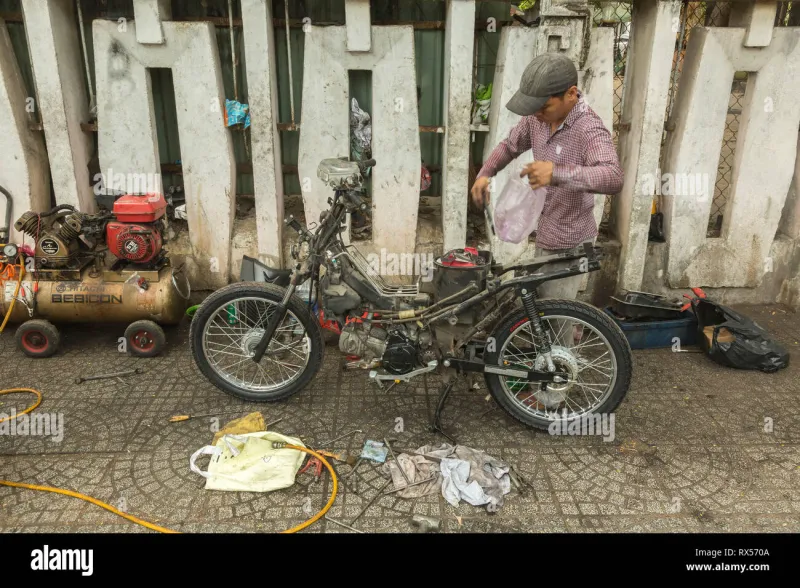
Photo: Vietnamese motorbike mechanic workshop alley Ho Chi Minh City, via c8.alamy.com
The sign above the workshop is barely legible — sun-bleached vinyl, a phone number with too many digits, a hand-painted Honda logo that someone clearly freestyled in 1994. Inside, a man named Tuấn is elbow-deep in a Yamaha Exciter, humming something that sounds vaguely like a 1970s pop song, while his apprentice — a kid who can't be older than nineteen — holds a flashlight and listens. Not to the engine. To Tuấn.
He's talking about the neighborhood. About the house that used to stand where the parking garage now is. About the family that lived there, what they sold, what happened to them after 1975. The apprentice doesn't take notes. He doesn't need to. This is how it's always been transmitted.
Saigon has nine million motorbikes and roughly as many repair shops. You'll find them crammed into alleys, spilling onto sidewalks, operating out of ground-floor apartments where the living room became a workshop sometime in the 1980s and never changed back. Americans tend to walk past them without a second glance. That's a mistake. These places are, quietly and without any particular fanfare, some of the most important historical institutions in the city.
The Workshop as Archive
Think about what a motorbike shop actually is in Saigon. It's a fixed point. Families run them for generations, in the same spot, serving the same streets. The mechanic who fixes your bike today might be the grandson of the man who fixed pedicabs in the same alley sixty years ago. That kind of continuity is vanishingly rare in a city that has been bulldozed, renamed, flooded, bombed, reunified, and Instagrammed into a dozen different versions of itself.
Because the shop doesn't move, the stories don't move either. They accumulate. A mechanic in District 3 once told a journalist — somewhat offhandedly, between tightening bolts — that he knew which buildings in his neighborhood had been used as safe houses during the American War, not because he'd read it anywhere, but because his father had told him, and his father had seen it. That kind of knowledge doesn't exist in any archive. It exists in workshops like his.
Customers are part of the circuit too. People wait. They sit on those ubiquitous plastic stools, drink free tea or iced coffee if the shop is generous, and they talk. About prices, about traffic, about which street got repaved, about who died last month and who their grandfather was. The mechanic listens while he works, contributes when he has something to add, and files it away. The workshop becomes a clearinghouse for neighborhood intelligence — social, historical, and deeply human.
What Gets Passed Down (And What Doesn't)
The technical knowledge is only part of the inheritance. Ask a veteran mechanic what he learned from his teacher and he'll probably list carburetor calibration, electrical diagnostics, the particular temperament of Chinese-made engines versus Japanese ones. But keep asking. The other list is longer.
Which families on this block were Northerners who came south after reunification. Which buildings used to be something else — a cinema, a pharmacy, a school. Where the old market was before they tore it down. What the street sounded like before the flyover went up. Who the neighborhood elder was, what he believed, why people respected him.
This is oral history in its most unself-conscious form. Nobody decided to preserve it. Nobody applied for a grant or set up a recording studio. It persists because it's useful — because knowing your neighborhood, its layers and its people, is part of how you operate within it. The mechanics aren't archivists. They're just paying attention.
What gets lost is harder to catalog. Knowledge dies with the person who holds it. An elderly mechanic in Bình Thạnh who remembered the exact layout of a pre-war market district passed away a few years back, and with him went details that no book had ever captured. His apprentice remembered the broad strokes. The specifics — the names, the stall numbers, the smells — those are gone.
The Apprentice Problem
There's a tension building in the trade that threatens the whole informal system. Younger mechanics are increasingly trained in formal vocational schools, which is great for standardization and not so great for continuity. The school teaches you how to fix the bike. It doesn't teach you the neighborhood.
Some older mechanics are aware of this and compensate deliberately, treating the oral tradition as seriously as the technical one. Others have given up, assuming the kids aren't interested. Some kids genuinely aren't. But plenty are — they just need to be invited in. The ones who stay, who spend years in a single shop rather than moving from gig to gig, tend to absorb the stories almost by osmosis. The ones who treat it like a job rather than a vocation tend to leave with only the mechanical skills intact.
There are also efforts — modest, underfunded, but real — to document what these shops carry. A handful of Vietnamese oral historians and independent journalists have been recording conversations with longtime mechanics, treating their workshops the way ethnographers treat indigenous communities: as places where irreplaceable knowledge is stored in human beings rather than hard drives. The recordings exist. Whether anyone will ever hear them at scale is another question.
What Travelers Can Actually Do
You don't need to manufacture a breakdown to get access to this world, though if your rented scooter does act up, consider it a gift. What you need is time and the willingness to sit still.
Find a shop on a quieter side street — not the tourist-district operations that cater to foreigners with flat tires, but the neighborhood places where the clientele is entirely local. Order something from the cart next door. Sit down. If your Vietnamese is nonexistent, that's genuinely okay — a lot of communication in these spaces happens through gesture, expression, and the universal language of watching someone do skilled work. If you have even basic phrases, use them. The effort is noticed and appreciated.
And if you get lucky enough to have a conversation, listen more than you talk. These mechanics aren't tour guides. They're not performing Saigon for your benefit. They're just people who happen to know things — about this street, this block, this city — that you will not find anywhere else. That's the whole point.
Saigon's official history is well-documented, endlessly photographed, and available in every guidebook. The other history — the one that lives in grease-stained hands and half-finished sentences over the sound of an impact wrench — is a lot harder to find. But it's there, in every alley workshop in every district, waiting for someone to pull up a stool and actually listen.