Roots, Bark, and Bone: The Underground Healers Who Kept Saigon Breathing
There's a smell in certain corners of Saigon that stops you cold — dried chrysanthemum, star anise, something bitter and woody you can't name, all of it floating out of a doorway that looks like it hasn't changed since the French were still arguing about who owned the river. You're not imagining it. You've just stumbled into one of the city's oldest operating systems: the network of herbalists, apothecaries, and street healers who kept Saigon alive when modern medicine was either too expensive, too foreign, or simply nowhere to be found.
For American tourists used to Walgreens on every corner, this world can feel like theater. It isn't. It's infrastructure — and understanding it changes how you read the entire city.
When the Pharmacy Didn't Exist
Saigon has always been a city that improvised. French colonial administrators built hospitals for French bodies. Vietnamese, Chinese, and Khmer residents made do with what they had — which, as it turned out, was considerable. Cholon, the dense Chinese district wedged into what's now District 5, became the city's unofficial medical supply chain. Merchants who had emigrated from Guangdong and Fujian provinces brought with them entire pharmacopeias: dried seahorses, ginseng roots the size of a fist, powdered deer antler, bark strips that treated everything from fever to heartbreak depending on who you asked.
These weren't fringe practices. For the majority of Saigon's population through the 19th and early 20th centuries, a Chinese herbalist in Cholon was the doctor. Full stop.
Then came the wars — plural, stacked, relentless. During the American War, when supply lines collapsed and hospitals were overwhelmed, the herbalists and backstreet healers didn't just survive. They became essential. Families kept bundles of dried herbs in the same drawer as their identity papers. Midwives doubled as pharmacists. Street vendors sold fever remedies alongside bánh mì. The line between food and medicine, never rigid in Vietnamese culture, dissolved entirely.
Cholon's Medicine Halls: Still Open, Still Serious
If you want to walk this history with your own feet, start at Hải Thượng Lãn Ông Street in District 5. Named after an 18th-century Vietnamese physician who is essentially the country's Hippocrates, the street is still lined with traditional medicine shops that have been in the same families for three and four generations. The signage is often in both Vietnamese and Chinese. The wooden cabinets inside hold hundreds of labeled drawers. The smell hits you like a wall in the best possible way.
Don't just browse. Talk to the people behind the counter if you can manage it — many younger family members speak some English, and they're often quietly proud to explain what their grandparents built. You'll hear about the postwar years when imported pharmaceuticals vanished almost overnight and these shops became the only option for entire neighborhoods. You'll also hear about the customers who still come in today not because they can't afford a clinic, but because they don't trust one.
That distrust isn't irrational. It's historical. It's earned.
The Street Healers Nobody Photographs
Beyond the medicine halls, Saigon's healing culture gets stranger and more personal. In the older residential districts — parts of District 1 near Bến Thành, the quieter lanes of District 3, the back alleys of Bình Thạnh — you'll find practitioners of thuốc nam, traditional Southern Vietnamese herbal medicine, operating out of spaces that look like living rooms because they are living rooms.
These aren't tourist attractions. They're active practices. An elderly woman with a reputation for treating digestive ailments might see a dozen patients before noon. A man who learned bone-setting from his father might work out of a converted garage. Some of them have formal training in traditional medicine from Vietnamese universities. Some learned exclusively from family. The credentials are different from what you'd expect, but the knowledge is real and often staggeringly deep.
Khmer healing traditions also run quietly through parts of the city, particularly in communities with roots in the Mekong Delta. Certain plants used in Khmer medicine — turmeric preparations, specific palm-derived remedies — appear in Saigon's street markets in ways that most visitors walk right past.
The Herb Markets: A Living Pharmacy
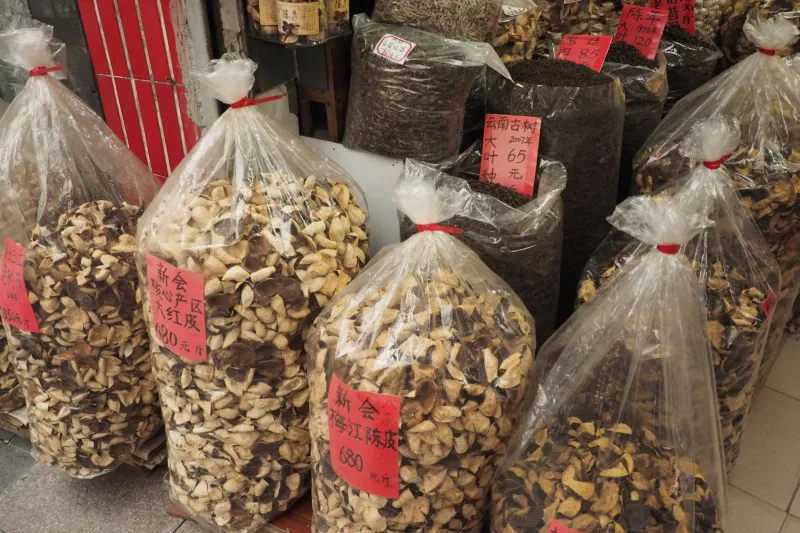
For a sensory experience that doubles as a history lesson, find your way to the herb sections of Bình Tây Market in Cholon or the smaller medicinal plant vendors scattered through Bến Thành's back stalls. What you're looking at is a pharmacopeia assembled over centuries — plants sourced from the Central Highlands, dried roots traded up from the Delta, imported Chinese ingredients that have been moving through this city since the 1700s.
Ask a vendor to show you ngải cứu — mugwort — and watch their face light up. That plant alone carries enough medicinal history to fill a book. It's been used for everything from menstrual regulation to wound treatment to the kind of full-body ache that a war produces. It grows on roadsides. It costs almost nothing. It was here long before any hospital.
What Postwar Scarcity Built
After 1975, the reunified government's early economic policies gutted the formal pharmaceutical supply chain. What filled the gap was exactly what had always been there: the herbalists, the healers, the families who knew which root to boil and for how long. The period between 1975 and the Đổi Mới economic reforms of 1986 was genuinely brutal for most Saigonese — but it also calcified something in the city's character. A bone-deep conviction that you handle your own health. That you know your own body. That the person on the corner with forty years of knowledge is at least as trustworthy as the institution with the fluorescent lights.
That conviction hasn't evaporated. Walk into any Saigon household and you'll likely find a stash of dried herbs somewhere — not as a quirky cultural artifact, but as a functioning first-response kit.
How to Engage Without Being a Tourist About It
If you want to explore this world with any real depth, a few ground rules help. Don't treat medicine halls like photo ops — ask before you shoot, and consider not shooting at all. Buy something small if you're going to take up a practitioner's time. A packet of dried lotus heart tea costs almost nothing and tells the vendor you're a person, not a spectator.
Several reputable tour operators in Saigon now offer walking tours specifically focused on traditional medicine culture in Cholon — these are worth considering if you want context before you wander. The Hội Y Học Cổ Truyền, Vietnam's Traditional Medicine Association, also has resources and practitioners who occasionally offer educational consultations for visitors.
And if you find yourself standing in a narrow shop while an 80-year-old woman explains which bark you should be drinking for your chronic knee problem — listen. She's probably right. She's been right for a very long time.
The City That Never Fully Surrendered to the Clinic
Saigon is many things at once: a gleaming metropolis with world-class hospitals and a street-level civilization that has never entirely needed them. The pharmacists, herbalists, and healers who built this shadow infrastructure didn't do it out of romanticism. They did it because survival required it. And in doing so, they created something the city's skyscrapers and coffee chains haven't replaced — a living, breathing record of how people take care of each other when the system fails.
That record is still open for reading. You just have to know which alley to turn down.