Forget the Algorithm: Why Saigon's Cyclo Drivers Know This City Better Than Your Phone Ever Will
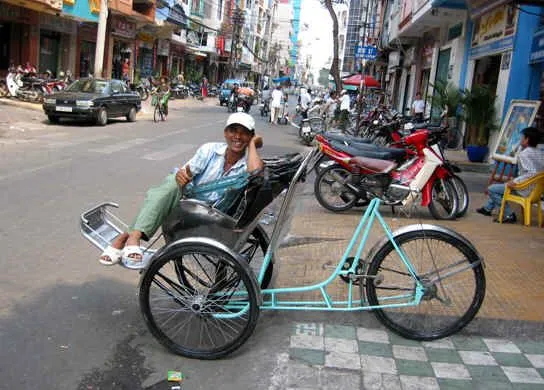
Photo: cyclo driver streets Ho Chi Minh City Vietnam traditional, via i.pinimg.com
Your phone is going to fail you in Saigon. Not because the signal drops or the battery dies — though both will happen — but because the city you're actually moving through doesn't exist in any database. The alley that smells like frangipani and fish sauce at six in the morning, the shortcut that only opens up when the school lets out, the block that floods every September and forces traffic into a completely different rhythm: none of that is in an app. But a cyclo driver knows all of it.
These guys — and it is almost always guys, most of them older, most of them carrying decades of mileage in their legs and their memories — are the original navigation system of Ho Chi Minh City. They predate Google Maps by about fifty years and, depending on who you ask, they're considerably more reliable.
The Education Nobody Gives You a Diploma For
Most cyclo drivers working Saigon's streets today started learning the city before reunification. Some of them pedaled passengers through the chaos of the 1970s, the economic stagnation of the 1980s, and the electric, disorienting boom of the Đổi Mới era. Each decade reshuffled the deck — streets were renamed, neighborhoods bulldozed, landmarks swapped out like furniture. These drivers absorbed every change the way a tree absorbs weather: quietly, incrementally, and permanently.
Ask Nguyễn Văn Hùng, who has been cycling passengers through District 1 for over thirty years, what used to stand at a particular corner on Lê Lợi, and he won't hesitate. He'll tell you about the tailor shop that moved three times before it finally closed, the café that became a phone repair stall that became a bubble tea franchise. He carries the city's history in layers, the way old paint shows through chipped walls.
This isn't nostalgia for its own sake. It's functional intelligence. When a road closes for construction — which in Saigon happens roughly as often as sunrise — a cyclo driver already knows four alternative routes, ranked by time of day and traffic pattern. No rerouting required. No spinning loading circle.
What the Back Alleys Actually Sound Like
There's a particular quality to moving through Saigon by cyclo that no other mode of transport replicates. You're sitting forward, slightly elevated, open to everything. The city doesn't filter itself for you. You catch the sharp ammonia drift from a wet market, the low bass of a motorbike engine, a grandmother arguing with a vegetable vendor in a dialect that hasn't changed in sixty years. You are inside the city, not sliding past it behind glass.
The drivers navigate by sensation as much as by sight. They know which intersections are dangerous at dusk because the sun hits a certain angle and blinds the cross traffic. They know which food stalls are worth stopping at because they've been stopping there for twenty years. They know which streets feel wrong on certain days — a vague, accumulated sense of the city's mood that no algorithm could ever model.
For American tourists accustomed to the curated efficiency of ride-share apps, this can feel disorienting at first. You're not in control of the route. You're not watching a blue dot move across a screen. You're trusting a human being who has spent his entire adult life in this specific place, which, if you think about it for more than thirty seconds, is a far more rational form of trust than trusting a satellite.
The Relationship Economy
Cyclo drivers don't just know the city's geography. They know its people. Regular passengers — shopkeepers, market vendors, elderly residents who never learned to ride motorbikes — have been climbing into the same drivers' rigs for years. These are relationships built on reliability and mutual recognition, the kind of social infrastructure that makes a neighborhood function.
Drivers often serve as informal messengers, delivering small packages between shops, passing along news, keeping track of who's sick and who's moved away. In a city that moves as fast as Saigon, they're one of the few forces that actually slow down long enough to notice what's happening at street level.
For tourists, tapping into even a fraction of this network is possible — and worth the effort. Don't just hire a cyclo for a single loop around the tourist circuit. Talk to your driver. Ask him what's changed in the last ten years. Ask him what he misses. Ask him where he eats lunch. The answers will tell you more about Saigon than any guidebook printed in the last decade.
Getting Deliberately Lost
Here's the move that most visitors never make: tell your driver you don't have a destination. Hand over an hour of your afternoon and ask him to show you something he thinks is worth seeing. Not something on a tourist map. Something he actually finds interesting.
What happens next varies by driver, by neighborhood, by time of day — but it's almost never boring. You might end up at a century-old temple tucked behind a parking garage. You might stop at a stretch of canal that used to be a market street and still carries the architectural ghost of what it was. You might just sit at a plastic stool somewhere and drink iced tea while the driver greets approximately fifteen people he knows by name.
This is the Saigon that doesn't photograph easily and doesn't trend on Instagram. It's the city that exists in the accumulated daily experience of the people who actually live here — and cyclo drivers, more than almost anyone else, have been accumulating that experience for a very long time.
Before They're Gone
It would be dishonest not to acknowledge the pressure these drivers are under. Ride-hailing apps dominate urban transport in Vietnam now, and the economics for cyclo drivers have gotten brutal. The number of working cyclos in Ho Chi Minh City has dropped sharply over the past two decades. The drivers who remain are older. Fewer young men are stepping into the trade.
Which means that every cyclo ride you take right now is, in some quiet way, an act of archival work. You're not just getting from point A to point B. You're spending time with someone who carries an irreplaceable map of this city inside him — a map made of memory, relationship, and fifty years of paying attention.
Google can tell you how many minutes it takes to get to the War Remnants Museum. It cannot tell you what that block smelled like in 1975, or who used to sell flowers on that corner, or why the old men in the café across the street still turn their chairs to face a building that was demolished in 1998.
A cyclo driver can. If you ask.