Thread by Thread: The Fabric Dealers Quietly Saving Saigon's Textile Soul
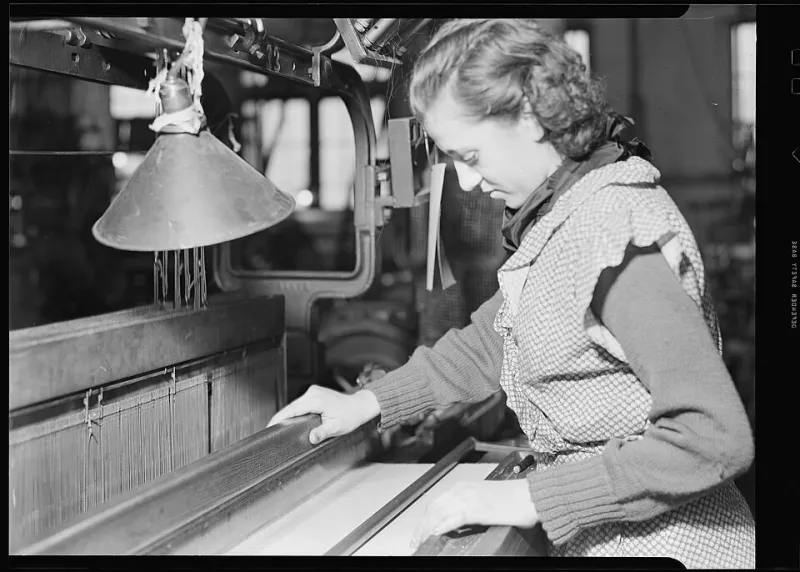
Photo: Lewis Hine, Public domain, via Wikimedia Commons
You could walk past Bà Hương's shop a hundred times and never stop. It sits wedged between a phone repair stall and a bánh mì cart on a narrow lane off Châu Văn Liêm, the kind of street that smells like diesel and steamed pork at the same time. The sign is faded. The storefront is maybe eight feet wide. Inside, bolts of fabric are stacked floor to ceiling — silk brocade, hand-dyed cotton, iridescent taffeta in colors that don't have English names.
Bà Hương is 74. She has been selling fabric in this exact location since 1971. Her mother sold fabric here before her. Her grandmother sold fabric one street over before the French rezoned the block.
"Every piece has a story," she says, running her thumb across a panel of dark indigo cloth. "Not a price. A story."
This is the part of Saigon that doesn't make the Instagram reels.
The Archive Nobody Built
When historians talk about preserving Vietnamese cultural heritage, they tend to think in terms of buildings, documents, and oral histories. What they rarely account for is textile. But for generations of Saigonese merchants — many of them ethnic Chinese families who settled in Cholon centuries ago — fabric has always been the medium through which history gets stored.
The weaving traditions represented inside these cramped shops span the Cham civilization of Central Vietnam, the imperial courts of Huế, the French colonial period's uneasy fusion of Vietnamese and European aesthetics, and the postwar economy's improvisational scramble for materials. Each era left a fingerprint in the cloth.
Nguyễn Minh Tuấn, a textile researcher at a Ho Chi Minh City university who asked that his institution not be named, has spent the last decade quietly cataloging what he calls "merchant archives" — the pattern books, fabric samples, and weaving notes passed down through trading families rather than deposited in any official collection.
"What these families hold is irreplaceable," he says. "Some of the patterns I've documented exist nowhere else. Not in the national museum. Not in academic literature. Only here, in a shop drawer, wrapped in newspaper from 1988."
Silk Road, Saigon Edition
The concentration of fabric merchants in what is now District 5 isn't accidental. Cholon — the old Chinese quarter that eventually merged into the broader city — was historically one of Southeast Asia's most important textile trading hubs. Merchants from Guangdong and Fujian provinces brought not just goods but techniques: methods of dyeing, weaving structures, and quality standards that blended with existing Vietnamese craft traditions over generations.
Bà Hương's family came from Fujian province four generations ago. But ask her about her stock and she'll describe it in terms that are distinctly, fiercely Vietnamese. "This pattern," she says, pulling out a length of red silk with a geometric border, "was used for áo dài in the 1950s. Before the war changed everything. My mother kept three bolts because she knew it would disappear."
She was right. That specific brocade pattern — tied to a particular loom configuration used by weavers in Hội An before industrialization wiped out the workshop — no longer exists in commercial production. What Bà Hương has in that back room is, effectively, a primary source.
What a Bolt of Fabric Remembers
A few blocks away, Chú Phát runs a slightly larger operation — two rooms, a teenage grandson helping fold stock, a hand-painted ledger system that would give a Western accountant a minor breakdown. He's been in the business for 45 years and has watched the neighborhood change in ways that trouble him.
"The young designers come in sometimes," he says. "From the fashion schools. They want something 'traditional.' But they don't know what they're looking at. They want the look without the knowledge."
What Chú Phát means is this: traditional Vietnamese textiles aren't just visual. They carry structural information — the weight of the weave, the behavior of the dye under different light, the way the cloth moves on a body — that can't be reproduced by simply copying a pattern digitally. The knowledge of why something was made a certain way lives in the hands of people like him. And those hands are getting older.
His son works in logistics. His daughter is a pharmacist. Neither has shown interest in the shop.
"I'm not sad," he says, in a way that makes it clear he is. "Things change. But someone should write it down."
The Disappearing Craft
The economic pressures bearing down on Saigon's textile merchants are relentless. Fast fashion has trained a generation of consumers to expect fabric at prices that make handwoven, traditionally dyed cloth seem absurd. Industrial imports from China flood the market. Younger Vietnamese designers — talented, internationally trained, genuinely committed to their heritage — often can't afford to source authentic materials even when they want to.
And then there's real estate. Cholon's backstreets, once a labyrinth of specialty traders, are steadily being absorbed by development. Shops that have operated for three generations are being priced out or bought out. Each one that closes takes its inventory — and more critically, its institutional knowledge — with it.
Tuấn, the textile researcher, is trying to work faster. He photographs, measures, and documents as many samples as families will allow. Some are protective of their archives; others are grateful someone is paying attention. "I've had merchants hand me things and say, 'Take it. I don't want it to disappear into a trash pile when I die.'" He pauses. "That's not how cultural heritage should be transferred."
Why It Matters to You
If you're visiting Saigon and you want to understand the city at a level that goes deeper than war museums and rooftop bars, spend an afternoon in Cholon's fabric lanes. You don't need to buy anything (though you probably will — the silk is extraordinary). Just look. Ask questions. The merchants who've been here the longest are often willing to talk if you show genuine curiosity rather than just hunting for a bargain.
Bà Hương, before you leave her shop, will probably unfurl something extraordinary — a piece she doesn't sell, just keeps — and hold it up to the light coming through her narrow doorway. The colors shift. The weave reveals itself. Four generations of memory, pressed into thread.
Saigon keeps its history in strange places. This is one of them.