When the Water Rises, Saigon Prays: The Ancient Flood Rituals That Still Run This City
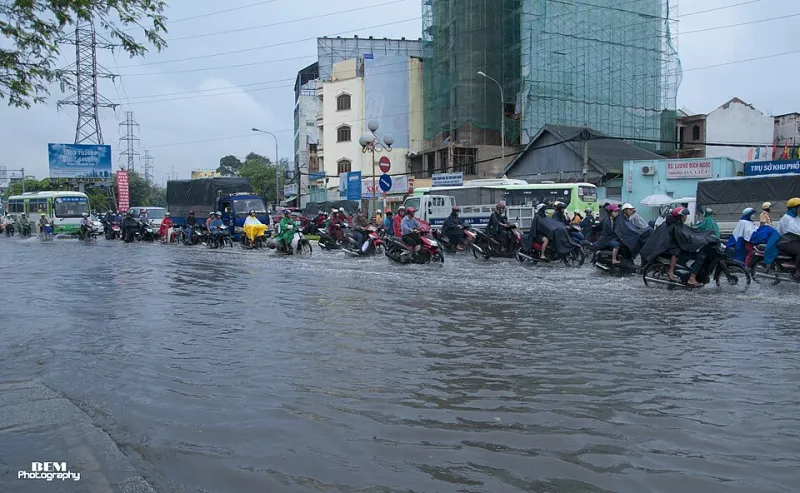
Photo: Bem photography:, CC BY 2.0, via Wikimedia Commons
The first time Melissa Tran flooded her rental apartment in District 4, she did what any American expat would do: she called her landlord, filed a complaint, and bought a dehumidifier. Her neighbor, a retired schoolteacher named Cô Mai, watched this process with polite bewilderment.
"She didn't make an offering," Cô Mai explained later, shaking her head with the gentle resignation of someone watching a person walk past an open umbrella stand in a thunderstorm. "So of course it happened again."
This is Saigon in monsoon season. The rain isn't just weather. It's a negotiation.
The City That Lives in Water
Ho Chi Minh City is, at its geological core, a city that has no business being where it is. Built on a delta, threaded through with canals, sitting barely a meter above sea level in its lower districts, Saigon has been in a permanent argument with water since the first settlements appeared here centuries ago. The French tried to engineer their way out of the problem. The postwar government tried to plan its way out. Neither fully succeeded.
What the Saigonese figured out — long before any of those administrations arrived — was that water couldn't be defeated. It could only be respected.
That philosophy produced a layered system of spiritual practices around flooding that still shapes daily life in ways visitors rarely notice. Some of it is rooted in Taoist and Buddhist traditions brought by Chinese settlers. Some of it is older than any of that — animist beliefs tied to the specific rivers, tides, and seasonal rhythms of the Mekong Delta region. And some of it is purely, pragmatically Saigonese: the accumulated wisdom of a city that has been wet before and knows exactly what that means.
The Calendar Nobody Publishes
If you ask a longtime Saigonese resident when to avoid major construction projects, they probably won't give you a weather forecast. They'll give you a lunar calendar reading.
The period roughly corresponding to the height of monsoon season — typically from May through October — is layered with auspicious and inauspicious dates that govern everything from when to pour a foundation to when to move furniture. Certain days within this window are considered particularly dangerous for disturbing the earth, a belief tied to the idea that water spirits are most active and most easily offended during flood periods.
"My brother started building his house extension in the wrong month," says Lâm Văn Đức, a 58-year-old hardware store owner in Bình Thạnh. "Three floods in one week. His wife made him stop and consult a thầy phong thủy before they continued." He grins. "The next year, no problem."
Feng shui consultants — thầy phong thủy — do brisk business in Saigon before the rainy season begins. Not just for residential projects, but for commercial construction too. Developers who publicly embrace modern engineering quietly schedule private consultations about drainage orientation, doorway placement relative to water flow, and the spiritual implications of building on reclaimed canal land.
This isn't fringe behavior. It's mainstream enough that several contractors told us, off the record, that they build consultation fees into project budgets as a standard line item.
Offerings at the Threshold
Walk through older residential neighborhoods in Districts 3, 4, or Bình Thạnh during the first significant rains of the season and you'll notice small offerings left near doorways and at the edges of drainage channels — fruit, incense, sometimes a small cup of rice wine. These are gestures directed at the water spirits, the local guardian deities, or the ancestors associated with a specific property.
The practice varies by family, by neighborhood, and by the specific religious background of the household. But the underlying logic is consistent: the flood is not purely a meteorological event. It is an event with agency. And agency can be addressed.
Cô Mai, the retired schoolteacher who watched Melissa Tran's unprotected apartment suffer its second flooding, explained her own family's practice with quiet matter-of-factness. "When the first big rain comes, we clean the altar, we make offerings, we ask the water to pass through gently. Not to stop — you can't stop it. Just to be kind."
She paused, then added: "It usually is."
Where Ancient Wisdom Meets Urban Engineering
Saigon's flooding problem has gotten dramatically worse in recent decades, and not primarily because of climate change — though that's accelerating everything. The city has filled in most of its historic canal network to make room for roads and development. The natural drainage system that kept the delta's water moving has been, in large part, paved over.
Hydrologists and urban planners who work on the city's flood management challenges speak carefully when the topic of traditional water wisdom comes up. But several acknowledge, with varying degrees of reluctance, that some of what the old practices encoded was functionally sound.
"The prohibition on building in certain low-lying areas during specific months," says one engineer who works with the city's drainage authority and asked not to be named, "when you map it against historical flood data, it often corresponds to genuine high-risk periods. The spiritual framing is different from the engineering framing, but the conclusion is sometimes the same."
The canal-filling that stripped Saigon of its natural flood management capacity happened fastest and most aggressively in the 1990s and 2000s — decades when modernization pressure was highest and traditional knowledge was most likely to be dismissed as superstition. The consequences are now visible every monsoon season in streets that turn into rivers within twenty minutes of a heavy downpour.
Wedding Season and the Water
Not all flood traditions are about avoidance. Some are about timing.
Wedding planning in Saigon involves a consultation with the lunar calendar that most American couples planning a destination wedding here are completely unprepared for. The monsoon months carry specific auspicious and inauspicious dates for marriage, and the logic isn't just spiritual — a wedding flooded out by a meter of street water is a practical disaster as much as a symbolic one.
But the belief system goes deeper than logistics. Water, in Vietnamese cosmology, is associated with flow, abundance, and the movement of fortune. A wedding timed well relative to water's seasonal energy is thought to carry that flow into the marriage itself. A wedding timed badly is inviting stagnation.
"My daughter's wedding was planned three times," says Nguyễn Thị Lan, a seamstress in District 1. "Twice we changed the date because of what the calendar said. The third date was perfect. No rain, good flow, everything moved smoothly." She smiles. "Eleven years married. Two grandchildren."
The City Keeps Negotiating
Saigon is not going to stop flooding. The sea is rising, the canals are gone, and the concrete keeps spreading. But the city's spiritual relationship with water — the offerings, the consultations, the stubborn insistence that the flood has feelings and those feelings can be addressed — persists in ways that no amount of modernization has managed to fully displace.
For visitors, there's something genuinely moving about watching a city this size, this chaotic, this relentlessly forward-moving, still pause at the start of monsoon season to leave a piece of fruit at a drainage channel and ask the water to be kind.
It usually is. More or less.