Coffee, Spies, and the End of a World: The Legendary Table at Givral Café
There's a corner of Lam Son Square where nothing particularly interesting happens anymore. Tourists photograph the Opera House. Motorbikes negotiate the roundabout with the practiced indifference of seasoned swimmers. A gleaming shopping mall — the kind that could exist in Dallas or Dubai — hums with air conditioning and the soft percussion of escalators. Nothing about it suggests that this exact spot was once the most consequential café table in Southeast Asia.
That table belonged to Givral.
And if you wanted to understand what was really happening in the final decades of South Vietnam — not the official version, not the press release version, but the version that actually mattered — you pulled up a chair, ordered a café sua da, and listened.
The Room Where Everything Was Known and Nothing Was Said
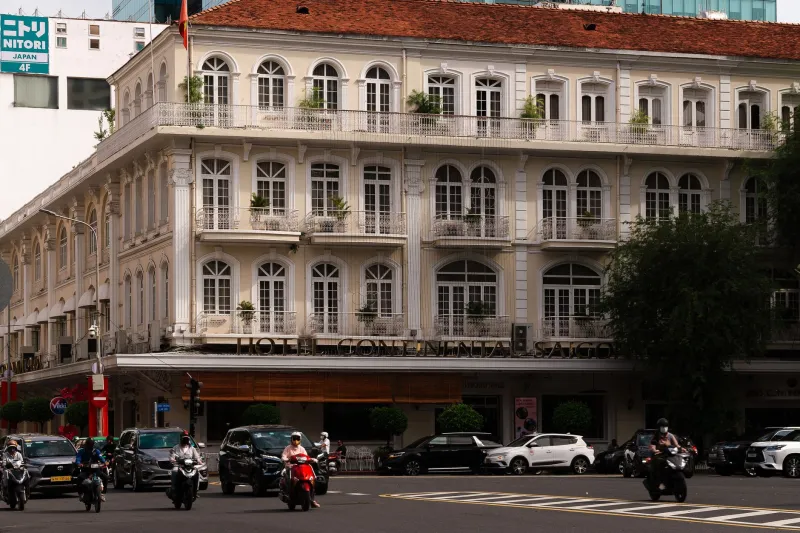
Givral Café opened in the 1950s on the ground floor of the Eden Building, directly across from the Continental Palace Hotel on one side and the National Assembly on the other. The location was almost absurdly symbolic. Power, press, and pastry within a single city block.
By the early 1960s, it had become what veteran war correspondents would later call the cauldron — a low-boil environment where information, rumor, and outright fabrication circulated so freely that distinguishing between them required years of practice. The clientele read like a casting call for a Cold War thriller: UPI and AP correspondents nursing deadlines and hangovers, South Vietnamese military officers performing casual indifference, French businessmen who had stayed too long and knew too much, and — though nobody confirmed it aloud — operatives from agencies that didn't officially operate in Vietnam.
Neil Davis, the legendary Australian cameraman who filmed some of the war's most iconic footage, was a regular. So were Peter Arnett, David Halberstam, and a rotating cast of journalists whose dispatches would eventually reshape American public opinion about the war they were covering from this very room. They came for the French pastries. They stayed because Givral was where things leaked.
Graham Greene's Shadow
The café's mythology predates even the American chapter of the war. Graham Greene, who spent time in Saigon in the early 1950s researching what would become The Quiet American, was a known presence in the neighborhood. While the Continental's terrace gets most of the literary credit, Givral existed in the same psychic geography — the triangle of colonial elegance and imperial anxiety that Greene dissected so precisely.
His fictional Fowler, the weary British journalist watching American idealism metastasize into catastrophe, could have filed his copy from Givral's corner table without changing a word. The café embodied exactly the quality Greene found so seductive and so damning about wartime Saigon: the way serious, world-altering events were conducted in rooms that smelled like butter and coffee, by people who looked like they were simply having lunch.
That contrast — the mundane surface, the catastrophic undertow — was Givral's defining characteristic. And it made the place genuinely dangerous.
Intelligence Work Disguised as Gossip
Former Saigon correspondents who've spoken to historians over the years describe Givral as a kind of involuntary intelligence network. You didn't have to be a spy to participate. You simply had to be present and paying attention.
A South Vietnamese colonel arrives for coffee and sits two tables from a man who, three years later, would be identified as a North Vietnamese intelligence asset. A CIA contractor — everyone knew, nobody said — nurses an iced tea at the counter and watches who talks to whom. A journalist overhears a fragment of conversation in Vietnamese, files it away, and two weeks later it becomes the lede of a story that runs on the front page of the New York Times.
This was how Saigon worked. And Givral was where Saigon worked hardest.
The café's physical layout helped. Street-facing windows meant you could see who was approaching before they arrived. Multiple exits meant you could leave without committing to a direction. The ambient noise of the city — horns, vendors, the occasional distant percussion of a war being fought in provinces that felt very close — meant that conversations at one table rarely carried to another. It was, structurally, a perfect room for people who needed to speak carefully.
April 1975 and the Last Cup
As the end approached — and by early 1975, everyone in Saigon knew the end was approaching, even if they disagreed about its timeline — Givral became something more than an intelligence hub. It became a grief room.
Correspondents who were there in those final weeks describe a café operating in a kind of suspended time. The pastries kept coming. The coffee was still good. But the conversations had shifted from information-gathering to something closer to eulogy. People were saying goodbye to a city, to a version of history, to each other.
On April 29, 1975 — the day before Saigon fell — several journalists made one last stop at Givral before the evacuation chaos consumed the city entirely. What they ordered, what they said, whether they paid the bill: these details vary depending on who's telling the story. What everyone agrees on is the atmosphere. It felt, one correspondent later wrote, like sitting in a painting that someone was about to roll up and put away.
The next morning, the city had a different name.
What the Mall Replaced
Givral survived reunification, operating in various forms through the late 20th century. But the Eden Building — the colonial-era structure that housed it — was eventually demolished as part of the redevelopment of Lam Son Square. In its place rose Vincom Center, a sleek commercial tower that houses international brands and a food court and absolutely nothing that remembers what stood there before.
This is not a story unique to Saigon. Cities erase their inconvenient rooms all the time. The building where Lincoln was shot became a government office. The Parisian cafés where the Resistance planned operations are now tourist destinations serving overpriced wine. Memory has always been at the mercy of real estate.
But there's something particular about Givral's erasure that deserves attention. The café wasn't just a place where history was observed — it was a place where history was made, in the way that informal information networks make history: quietly, deniably, and with enormous consequence. The journalists who drank there helped shape American understanding of a war that cost 58,000 American lives and millions of Vietnamese ones. The intelligence that flowed through its conversations influenced decisions made in Washington and Hanoi. That's not a small legacy to pave over.
Finding the Ghost
If you visit Lam Son Square today — and you should, because it's still one of the most atmospheric corners of Ho Chi Minh City — stand with your back to the Opera House and look toward Vincom Center. The Eden Building's footprint is roughly where the mall's main entrance now sits.
Nothing marks it. No plaque, no photograph, no small acknowledgment that the ground beneath the escalators once held one of the 20th century's most remarkable rooms.
But the square itself still carries something. The Continental Palace is still there, still serving drinks on its terrace, still watching the city renegotiate itself in real time. The Opera House still anchors the plaza with the particular authority of colonial architecture that refused to apologize for existing. The traffic still moves the way Saigon traffic always moves — with aggressive confidence and surprising grace.
Givral is gone. But the city it witnessed is very much alive, still hustling, still full of people who know more than they're saying. Some things don't need a building to survive.
They just need someone paying attention.