Glass, Ghosts, and Greed: Who Really Owns Saigon's Sky?
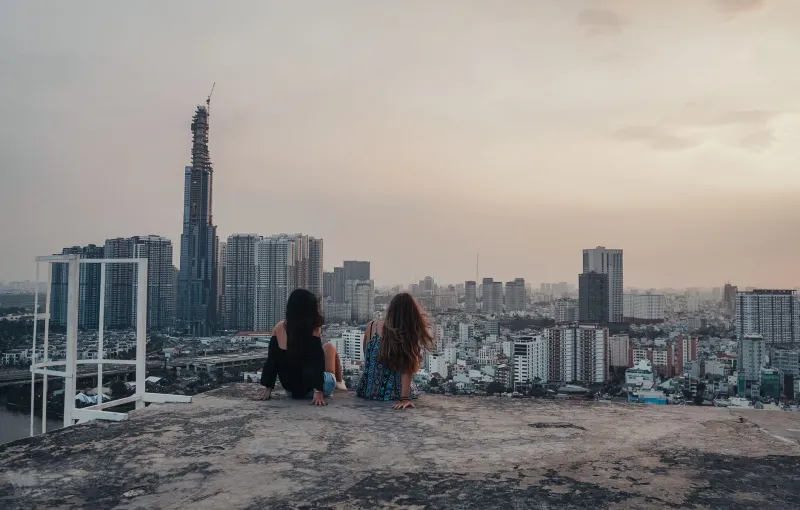
Stand on almost any rooftop bar in District 1 on a clear evening and the view is, genuinely, spectacular. The Saigon River catches the last light. Motorbikes trace luminous threads through the streets below. Glass towers blink on one by one like a city powering itself up from scratch. It's the kind of panorama that fills Instagram feeds and travel magazines and makes people back home say, wow, I had no idea Vietnam looked like that.
But look a little closer — past the craft cocktail in your hand and the lounge music drifting from the speakers — and you'll notice the gaps. Lots of them. Empty lots where buildings used to be. Scaffolded shells where neighborhoods once stood. And if you know where to look, the occasional ancestral altar sitting in the rubble of a courtyard that someone's family occupied for three or four generations before a development contract made that history inconvenient.
Saigon's skyline is being rewritten in real time. And the story behind that rewrite is a lot more complicated than the tourism brochures let on.
The Boom Is Real — and So Is What It's Replacing
Ho Chi Minh City is one of the fastest-urbanizing metros in Southeast Asia. Depending on which economist you ask, the city's real estate sector has been growing at somewhere between 8 and 15 percent annually for much of the last decade. International developers — from South Korea, Singapore, Japan, and increasingly the United States — have poured billions into mixed-use towers, luxury condominiums, and the kind of sky-high hospitality venues that cater to a global tourist class with serious spending power.
The results are visible everywhere. The Landmark 81, currently the tallest building in Vietnam, looms over Binh Thanh District like a punctuation mark on a sentence nobody finished writing. Entire blocks in Districts 2 and 4 have been cleared for master-planned developments that promise smart cities, integrated retail, and riverfront living. Construction cranes are so common they've practically become part of the skyline themselves.
What's harder to see — unless you're paying attention — is what those cranes are replacing.
A City That Has Already Been Erased Once
Saigon has a complicated relationship with its own built history. The French colonial period produced an architectural legacy — wide boulevards, shuttered villas, ornate civic buildings — that survived decades of war largely intact. The decades following reunification in 1975 brought a different kind of pressure: neglect, repurposing, and a political incentive to distance the city from its colonial and South Vietnamese past.
Some of that legacy endured anyway. The General Post Office. The Notre-Dame Cathedral. The Continental Hotel. Certain stretches of old Cholon. These buildings became anchors for a tourism narrative that frames Saigon as a city where history is still visible, still touchable.
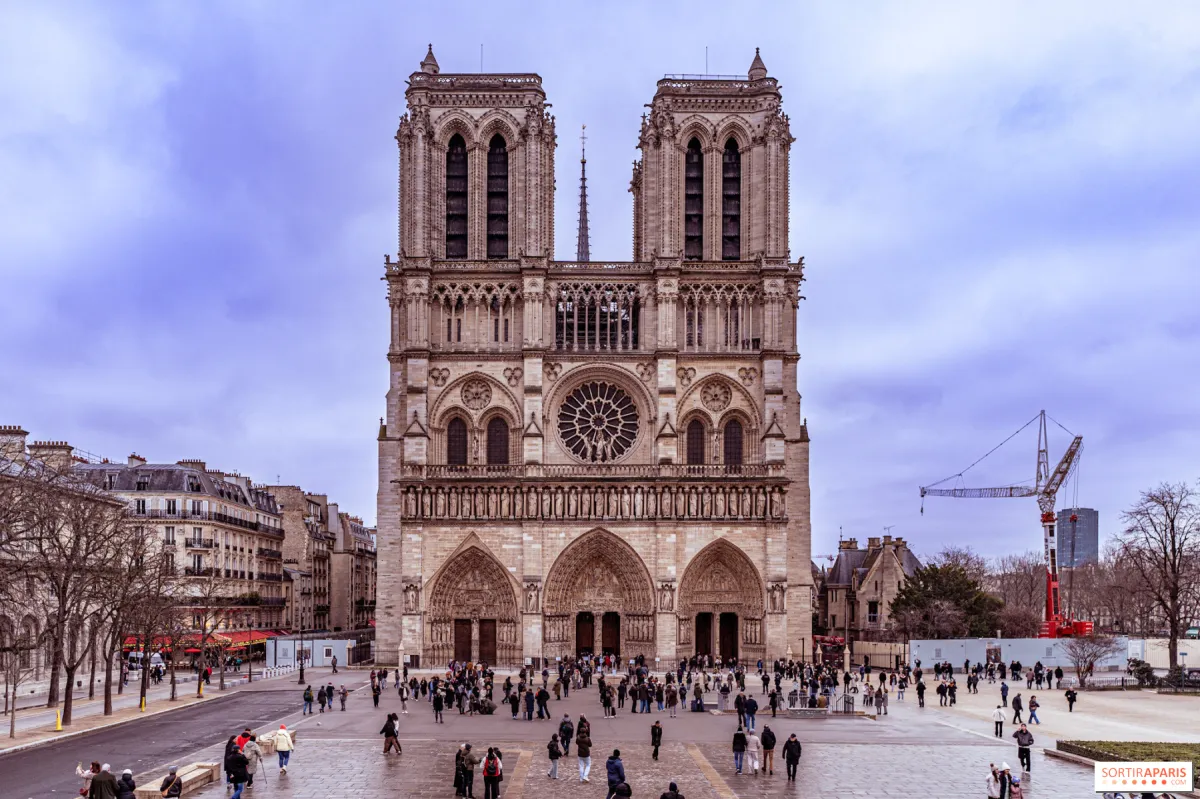 Photo: Notre-Dame Cathedral, via cdn.sortiraparis.com
But preservationists — and there's a growing, passionate community of them in Ho Chi Minh City — will tell you that the current development wave is more aggressive than anything that came before it. Buildings that survived the French, survived the American War, survived reunification and the lean years of the 1980s are now falling to something arguably more powerful than any of those forces: capital.
In 2023, a cluster of early 20th-century shophouses near Ben Thanh Market was quietly demolished ahead of infrastructure work tied to the city's long-delayed metro expansion. In District 3, a French-era villa that had housed multiple generations of the same family was cleared for a boutique hotel development. Residents were compensated — in theory — but the amounts were disputed, and the timeline for relocation gave families weeks, not months.
 Photo: Ben Thanh Market, via i5.walmartimages.com
Land, Ancestors, and the Concept That Doesn't Translate
Here's something most American visitors don't fully grasp until they've spent real time in Vietnam: the relationship between a Vietnamese family and the land they occupy is not purely economic. It is spiritual.
The concept of đất tổ — ancestral land — runs deep in Vietnamese culture. Land isn't just property. It's the physical location where ancestors are venerated, where the dead remain present, where family identity is literally rooted. Altars are placed not just inside homes but at the thresholds of properties, marking the boundary between the living family and the generations that preceded them.
When a building comes down, it isn't just a structure that disappears. In the eyes of many Vietnamese families, the displacement is also spiritual. The dead are disturbed. The continuity between generations is severed. This isn't metaphor — it's a genuinely held belief that shapes how families respond to demolition notices, how they negotiate (or refuse to negotiate) with developers, and how they mourn what's lost.
Western developers working in Ho Chi Minh City have learned, sometimes the hard way, that resistance to relocation isn't simply about money. A family that appears to be holding out for a better payout may actually be trying to find a way to relocate an altar, to perform the right ceremonies, to give their ancestors a proper transition. That's not a real estate problem. It's a religious one.
What You Can See — and What You Can Do
For American travelers, there's a particular temptation to experience Saigon as a kind of blank canvas — a city in the process of becoming something new, where the future feels more exciting than the past. That framing isn't entirely wrong. The energy here is genuinely electric, and the ambition of the city's younger generations is something to behold.
But it's worth complicating that narrative while you're here, not just after you've left.
Start by seeking out the neighborhoods that haven't been fully absorbed into the development machine yet. District 4, just across the canal from District 1, still has blocks that feel like the Saigon of thirty years ago — narrow alleys, family-run workshops, street food stalls that have been in the same spot for decades. Wander there before the cranes arrive.
Visit the HCMC Museum of Fine Arts in District 1, housed in a French-colonial building that has been threatened with adjacent development more than once. Talk to the staff. Ask about the building's history. The answers are illuminating.
If you're interested in the preservation fight specifically, look up organizations like Saigon Heritage or follow local architects and urban planners on Vietnamese social media — many are vocal about specific buildings and neighborhoods under threat, and they welcome international attention. Foreign visitors noticing and writing about these places creates a kind of soft pressure that purely local advocacy sometimes can't generate.
And when you're sitting at that rooftop bar, enjoying the view — take a moment to think about the elevation you're sitting at. What was there before the building beneath you existed? Who lived on that land? In a city where the dead are never entirely gone, those questions aren't morbid. They're just honest.
The View From Up Here
Saigon has always been a city of reinvention. That's part of what makes it magnetic. But reinvention and erasure are not the same thing, and the line between them is where a lot of the city's current tension lives.
When American tourists romanticize "new Saigon" — the gleaming towers, the rooftop cocktails, the sense of a city sprinting toward the future — we're participating in a story that has winners and losers, even if the losers are harder to see from 40 floors up. The families displaced from ancestral land. The shophouse owners who couldn't hold out against the developers. The altars that had to be moved, or weren't.
None of this means you shouldn't enjoy the view. Saigon's skyline is genuinely breathtaking, and the city's energy is one of the great travel experiences on the planet.
It just means the view is more complicated than it looks. And in this city, that's almost always true.