Stop Climbing. The Real Saigon Is Right Here at Street Level.
Somewhere between your third craft cocktail and your fourteenth attempt to get the skyline in focus on your phone, it hits you: you're looking at Saigon, but you're not really in it.
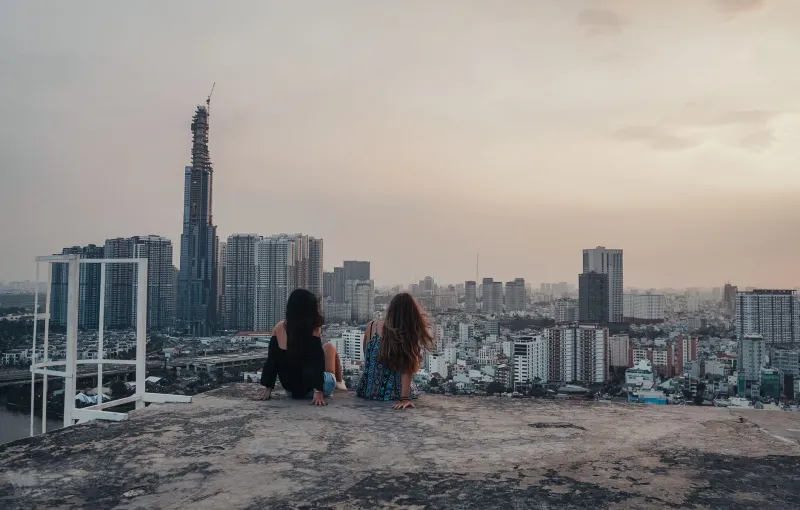
The rooftop bar experience in Ho Chi Minh City is genuinely beautiful. Nobody's going to pretend otherwise. The lights stretch out in every direction, the Bitexco Financial Tower blinks in the middle distance, and the hum of ten million lives rises up to meet you like something out of a movie. It's a real moment. But it's also, if we're being honest, a moment you could have in Dubai, Singapore, or Bangkok. The view is interchangeable. The vibe is imported.
 Photo: Ho Chi Minh City, via www.frankenthaler-tierschutzverein.de
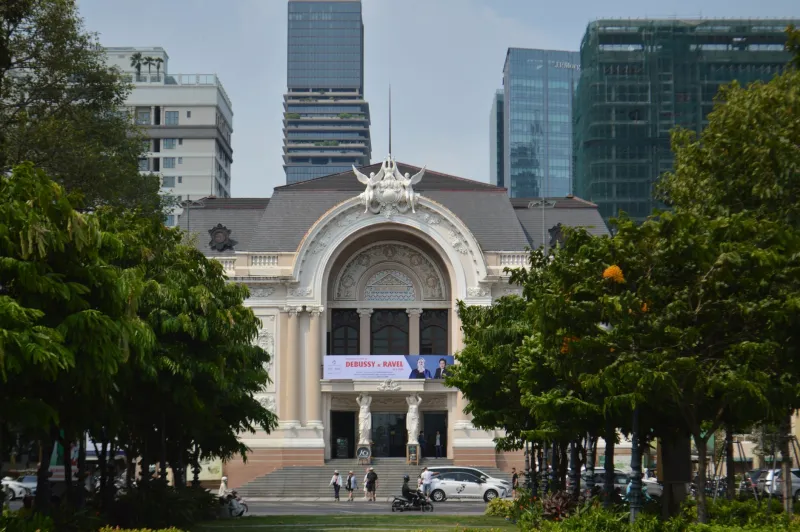
 Photo: Bitexco Financial Tower, via www.chemtube3d.com
The Saigon that made Saigon? That's down there. On the pavement. At the plastic table. Under the bare bulb.
What Rooftop Bars Are Actually Selling You
Let's not be precious about this. Saigon's rooftop bar scene — places like Chill Skybar, Social Club, and the revolving options at various five-stars — exists almost entirely for foreign visitors and a slice of the city's new moneyed class. They are beautifully engineered experiences: air-conditioned, English-menu'd, and priced to ensure that the crowd stays curated. A round of drinks can run you $30 or $40 USD without much effort. For context, a full meal with beers at a local spot might cost you $5.
None of that is a crime. But when those bars become your primary social experience in Saigon, you've essentially paid premium prices to see the city from behind glass. You've opted for the postcard instead of the place.
The Mezzanine Level: Where the Expats Finally Figure It Out
One floor below the rooftops — sometimes literally, sometimes figuratively — you start finding the city's middle layer. These are the open-air terrace restaurants, the second-floor beer halls with ceiling fans that haven't been replaced since 1994, the kind of places where long-term expats bring their visiting friends specifically to say this is what I was trying to explain.
These spots tend to cluster around Districts 1 and 3, tucked above pharmacies and tailoring shops. They're not hidden exactly, but they don't advertise on Instagram. The furniture is mismatched. The menus are laminated and cracked at the corners. The beer is cold and costs about 30,000 VND — roughly a dollar and a quarter.
What you get in exchange for the lack of ambiance is something money genuinely can't manufacture: the actual conversational texture of the city. Tables of Vietnamese office workers unwinding after a shift. Older men playing cards in the corner. A television mounted too high on the wall showing a soccer match nobody seems particularly invested in. This is the city at rest. And it's worth more than any panoramic view.
Ground Floor: The Bia Hơi Philosophy
Now we're talking.
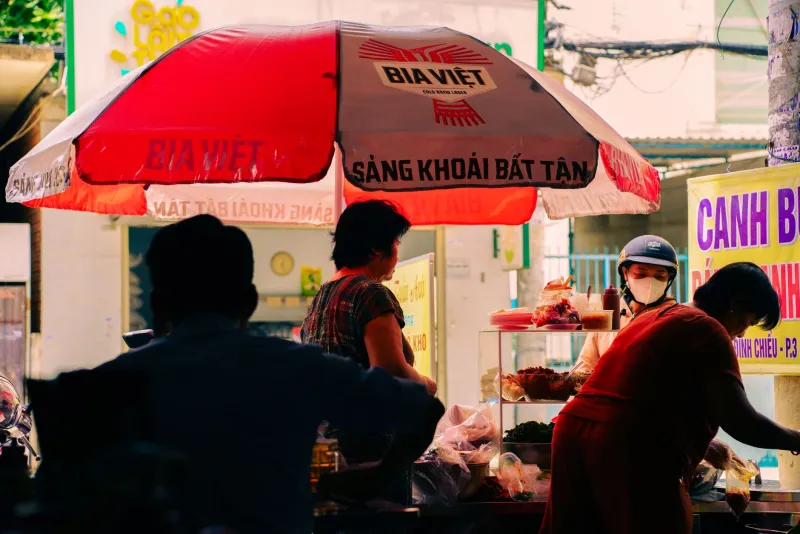
Bia hơi — fresh draft beer brewed daily and sold in small glasses for sometimes less than a dollar — is one of the most democratic institutions in Vietnamese social life. The concept originated in the north, in Hanoi, but Saigon has absorbed it fully and made it its own. You'll find bia hơi corners tucked along side streets in Bình Thạnh, sprawling across the sidewalk on Phạm Ngũ Lão, folded into the edges of wet markets that wind down for the evening.
The setup is always roughly the same: low plastic stools, low plastic tables, a keg or a cooler, and the understanding that you are here to sit, drink slowly, eat something fried, and talk. There is no soundtrack curated by a DJ. There is no cocktail list. There is no view. What there is, is proximity — to the street, to the city's noise and exhaust and laughter, to the actual human beings who live here.
For American tourists used to bars as performance spaces, bia hơi culture can feel disorienting at first. Nobody is posturing. Nobody is dressed to be seen. The point isn't the drink, really — it's the sitting. It's the being somewhere together. That's the whole thing.
Shophouses After Dark: The Living Room That Faces the Street
Saigon's old shophouse architecture — the narrow, deep buildings that line streets like Lý Tự Trọng and stretches of Đinh Tiên Hoàng — creates a drinking and eating culture unlike anything in the American experience. The front of the house opens completely to the street. There's no clear line between inside and outside, between the family's life and the public's gaze. You sit in what is functionally someone's living room and eat food cooked in what is functionally someone's kitchen, and the street rolls by two feet from your elbow.
These places often don't have names, or if they do, the name is just the matriarch's name followed by the dish she's been cooking for thirty years. They're not on Google Maps. They're found by walking slowly and following your nose, or by asking someone who's been in the city long enough to know.
This is where the legend of Saigon actually lives — not in the skyline, but in the continuity. A woman who learned to cook from her mother who learned from hers, feeding strangers in the same doorway for generations. That story doesn't photograph well from a rooftop. You have to come down to find it.
How to Make the Descent
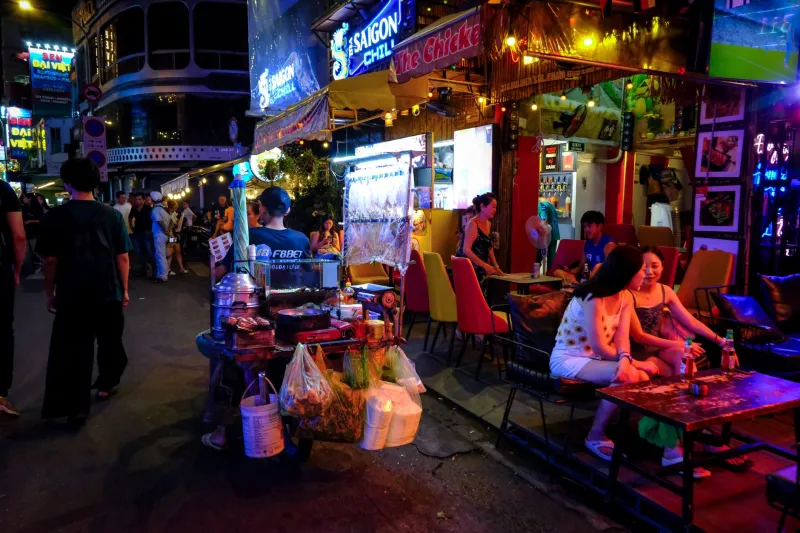
If you're in Saigon and you've been spending your evenings thirty floors up, here's the simplest possible reorientation: pick one night and don't go above the second floor. Start on Bùi Viện if you need training wheels — it's loud and tourist-friendly, but it's on the ground. Then push a few blocks north or east, away from the backpacker strip, and just walk until something smells good.
Sit down. Order whatever the table next to you is having. Don't ask for the English menu. Pay attention to how long people stay, how they talk, how the night moves differently when it's not organized around a view.
Saigon is one of the most layered, historically dense, emotionally complex cities on the planet. It survived colonization, war, reunification, and a market economy that arrived like a freight train. The people who lived through all of that didn't process it from a terrace with a craft gin and tonic. They processed it at street level, in plastic chairs, over cheap beer and loud conversation.
The rooftops are beautiful. Go once, get the photo, enjoy the breeze.
Then come back down. The real city is waiting.