Before the City Wakes: A Week Eating Saigon's Secret Pre-Dawn Street Food
The alarm goes off at 3:45 a.m. Outside my guesthouse window in District 4, the city is not asleep — it was never asleep — but it's running at a different frequency. The motorbike noise is different at this hour: purposeful, directional, people going somewhere specific rather than just moving through. I pull on a shirt, grab my notebook, and go looking for breakfast.
This is how I spent seven mornings in Saigon: eating before sunrise, following the vendors who feed the city before the city feeds everyone else.
Why Pre-Dawn Food Culture Exists at All
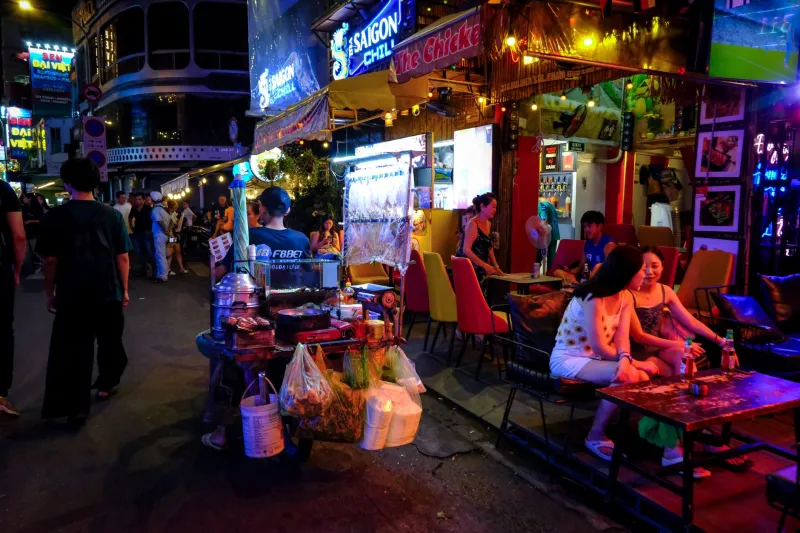
Saigon's pre-dawn food scene isn't an accident or a quirk. It's infrastructure. The city's wholesale markets — Bình Điền, Bình Tây, Thủ Đức — operate through the night, and the tens of thousands of workers who move through them need to eat. So do the xe ôm drivers (motorbike taxi operators) starting their shifts at 4 a.m., the construction crews arriving at sites before dawn, and the older generation of residents for whom waking at 4:30 is simply what you do.
 Photo: Bình Điền, via static1.thetravelimages.com
The vendors who serve them have built micro-economies around these hours. Their customers are regulars. Their recipes are calibrated for people who need sustenance, not Instagram content. And the food, I discovered quickly, is extraordinary.
Cô Lan and the Cháo Cart That's Been There for Forty Years
I found Cô Lan on my second morning, on a side street near the Bình Điền wholesale market in District 8. Her cháo (rice porridge) cart was the only light on the block at 4:15 a.m. — a single bare bulb hanging over a folding table, two massive pots, and a line of about twelve people who clearly came here every morning.
 Photo: Cô Lan, via i.ytimg.com
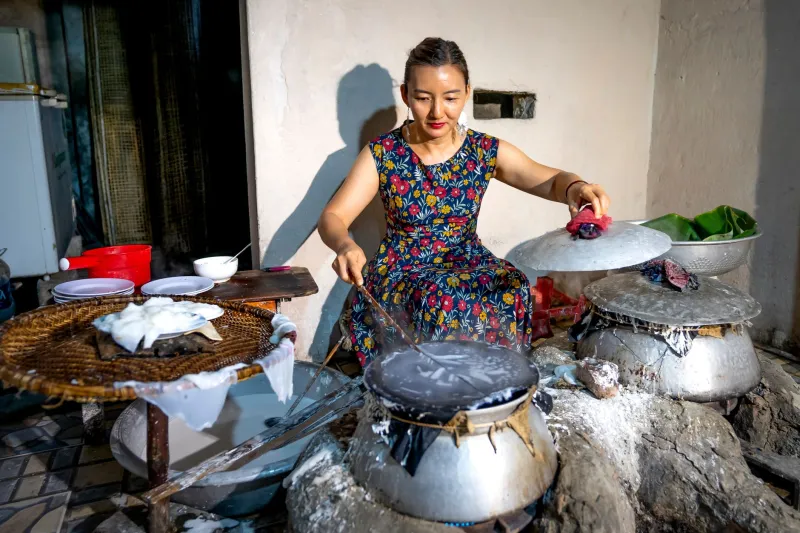
Cô Lan is 71. She started this cart when she was in her early thirties, she tells me through a young market worker who volunteers to translate, because her mother ran one before her and her mother's mother before that. The recipe for her cháo gà (chicken porridge) has not changed in three generations. Slow-cooked rice, a broth built from charred ginger and whole chicken bones, finished with shredded poached chicken, fried shallots, and white pepper. A bowl costs roughly 25,000 Vietnamese đồng — just over a dollar.
I eat two bowls.
There's something about porridge at 4 a.m. that defies easy explanation. It's the warmth of it, partly — the way it settles in your chest when the air is still cool and the city is still gathering itself. But it's also the precision of it. Cô Lan's cháo isn't simple food executed simply. It's simple food executed with forty years of accumulated knowledge. The broth is clear but deep. The chicken is soft without being mushy. The fried shallots add a crunch that resets every spoonful.
She feeds about sixty people before 6 a.m. and packs up by the time the sun is fully up. "Daytime customers want different things," she says, with what I interpret as mild disapproval.
The Bánh Mì Guy Who Starts at 3 a.m.
Anh Hùng is not what you picture when you think of a bánh mì vendor. He's 44, wiry, and moves with the efficiency of someone who has assembled approximately one million sandwiches. His cart sets up at 3 a.m. outside a logistics warehouse in Bình Thạnh, and by 5 a.m. he's usually sold out.
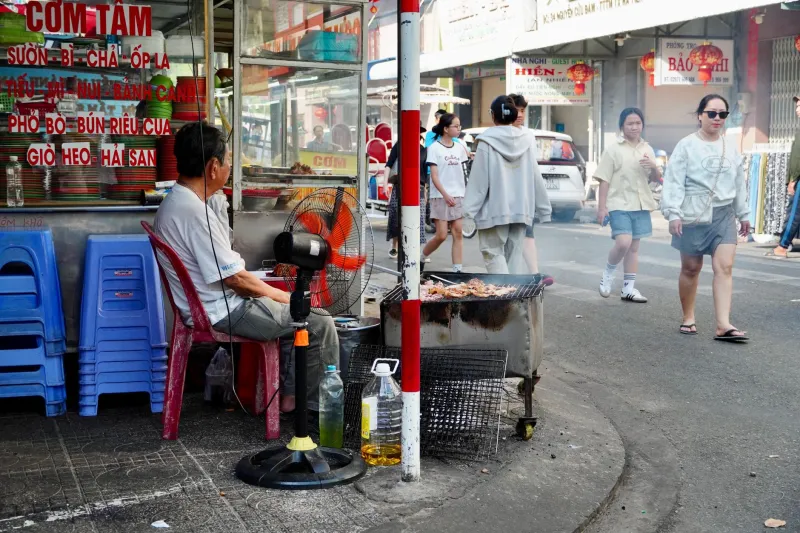
His bánh mì is not the tourist-facing version you'll find in District 1 — loaded with pâté, cucumber, cilantro, and daikon. Anh Hùng's version is built for speed and caloric density: a crackle-crusted baguette split open and filled with house-made pork floss, a smear of butter, Maggi seasoning, and a fried egg cooked directly on the cart's flat iron. The whole thing takes about 90 seconds to assemble and costs 20,000 đồng — less than a dollar.
It is, without question, one of the best things I ate all week.
"The bread is everything," Anh Hùng tells me, and he means it literally. He sources his baguettes from a bakery that starts its ovens at 1 a.m. specifically to have fresh bread ready for vendors like him by 2:30. This is the supply chain that most people never think about: a whole network of bakers, drivers, and vendors operating in the dark so that a warehouse worker can eat a hot breakfast at 3:45 a.m.
I ask him if he ever gets tired of the hours. He looks at me like the question doesn't quite compute. "My father drove a xe ôm from 3 a.m. to noon for thirty years," he says. "This is normal."
Bún Bò Huế at 5 a.m.: The Dish That Wakes You Up
If pho is Saigon's comfort food, bún bò Huế is its alarm clock. The spicy beef and pork noodle soup from central Vietnam is sharper, more aggressive, and more complex than its more famous cousin — lemongrass, shrimp paste, chili oil, and thick round noodles in a broth that hits you immediately.
Chị Thảo has been running her bún bò cart near the Văn Thánh bridge in Bình Thạnh since 5 a.m. every day for eleven years. She learned the recipe from her aunt in Huế and has adapted it slightly for Saigon palates — a little less funky, a little more chili — but the bones of it are unchanged. The broth starts the night before. The lemongrass goes in at midnight.
 Photo: Văn Thánh bridge, via www.picclickimg.com
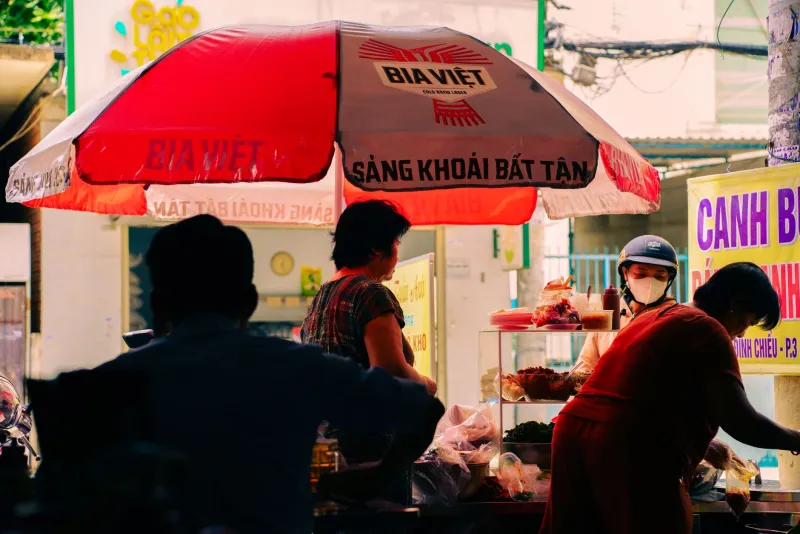
At 5:15 a.m. on a Thursday, I sit on a plastic stool with a bowl of her bún bò in front of me and watch the neighborhood transition. Motorbikes park and dismount. Workers in high-visibility vests pull up and order without looking at anything — they know what they want because they've been ordering it for years. A woman walks over with a thermos of cà phê and sets it on the table without being asked. This is a community, not a transaction.
What Pre-Dawn Food Tells You About Saigon
Here's what a week of 4 a.m. breakfasts taught me: Saigon's food culture isn't just delicious. It's structural. The vendors who operate before sunrise aren't serving a niche market — they're feeding the engine of a city that genuinely never stops. Their recipes are archives. Their carts are institutions. And the hours they keep are a kind of devotion that's hard to fully articulate until you're sitting in the dark with a bowl of porridge that tastes like three generations of someone's family.
The food tourism conversation in the US tends to focus on the photogenic stuff — the towers of pho, the grilled meats, the colorful bánh mì. All of that is real and worth chasing. But if you want to understand what Saigon actually is, set your alarm for 4 a.m. at least once. Walk toward the nearest market. Follow the light.
Somebody's already been up for hours, waiting to feed you.