Grandmother's Proportions: The Saigon Family Recipes That War, Exile, and Easy Money Couldn't Kill
Grandmother's Proportions: The Saigon Family Recipes That War, Exile, and Easy Money Couldn't Kill
There's a broth in District 5 that has been simmering, in one form or another, since the early 1950s. The woman tending it today is the granddaughter of the woman who first developed the ratio — a particular balance of charred ginger, caramelized shallot, and pork bone that her family refuses to write down, not because they want to keep it secret, but because they don't need to. It lives in muscle memory now. In the angle of a wrist. In the way three generations of women have pressed their thumbs into raw dough the same way, without instruction.
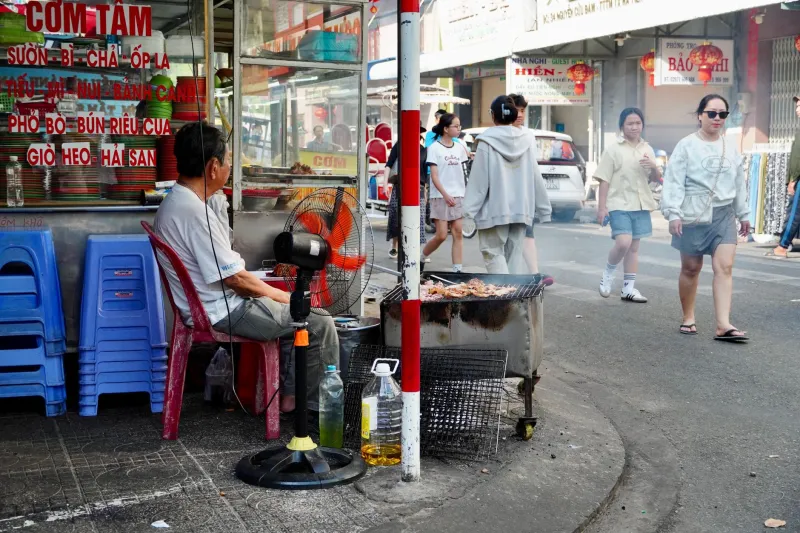
This is what culinary survival looks like in Saigon. Not a trend. Not a revival. Just continuity, stubbornly maintained through everything the twentieth century threw at this city.
What It Actually Means to Keep a Recipe Alive
American food culture loves a comeback story. A chef rediscovers grandma's meatloaf. A Brooklyn restaurant puts a Southern grandmother's biscuits on a tasting menu. We romanticize culinary heritage, but we also sanitize it — we forget that preserving a recipe through genuine upheaval is a different animal entirely.
In Saigon, keeping a recipe intact across the last seventy years meant cooking through French colonial rationing, through wartime ingredient shortages, through the post-1975 period when private commerce was effectively outlawed, and through the lean years of the late 1970s and early 1980s when feeding a family at all was the only ambition anyone could afford. The families who kept their dishes alive during those decades weren't preserving heritage as a concept. They were keeping something real and specific and irreplaceable from disappearing.
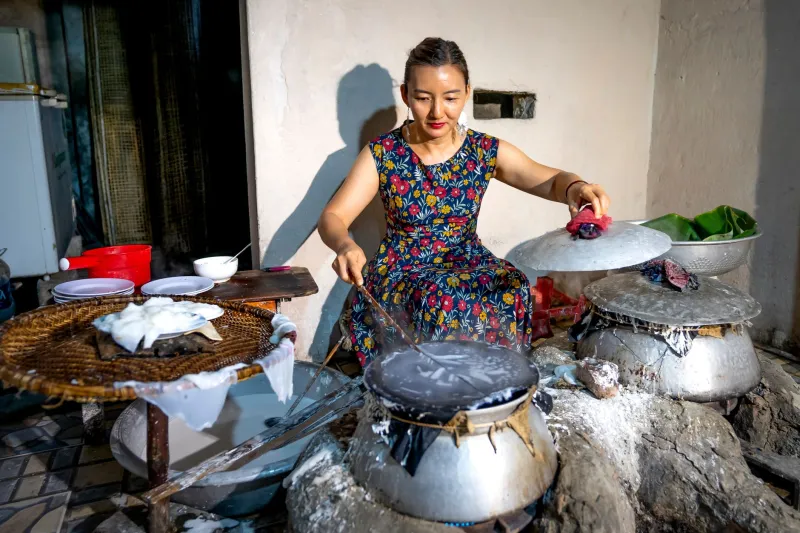
Third-generation cook Nguyễn Thị Lan, who runs a bánh cuốn stall in Bình Thạnh that her grandmother opened before the fall of Saigon, puts it plainly: "My grandmother didn't think of it as a recipe. She thought of it as the right way. There was her way and there was the wrong way. That's still how I think about it."
The right way, in her grandmother's kitchen, meant a specific wood-smoke technique for the steaming cloth, a particular fermented pork topping assembled in a fixed sequence, and a dipping sauce with a fish sauce-to-lime ratio that Lan can recite but says she's never actually measured. She's been making it since she was eight years old. The measurement is in her hands.
The Đổi Mới Test
If the war years tested whether these recipes could survive scarcity, the economic reforms of the late 1980s and the restaurant boom that followed tested whether they could survive abundance.
When Vietnam opened its doors to foreign investment and private enterprise flourished again, Saigon's food scene exploded. New money flowed in. Franchise inquiries arrived. Food writers and investors from Hanoi, from Singapore, from the United States started showing up at tiny family stalls with business cards and expansion proposals.
Some families took the deals. Some modernized their recipes to accommodate higher volume, cheaper ingredients, or tourist palates calibrated to a blander heat level. And some — a stubborn, remarkable few — said no.
Phạm Văn Hùng's family has been making hủ tiếu Nam Vang, the Cambodian-influenced pork and noodle soup that became a Saigon staple, from the same recipe his great-grandmother brought from Phnom Penh in the 1950s. He's been approached twice about expanding into a chain. Both times, he declined. "The moment you scale it up, you have to compromise something," he says. "Maybe it's the pork quality. Maybe it's the time the bones simmer. Maybe it's something you can't even name. But the soup knows. The soup changes."
His soup does not change. It takes six hours minimum. It uses a specific cut his supplier holds for him. It is served in one location, at one counter, during hours that end when the pot is empty.
The Recipes That Crossed the Pacific
Here's where the story gets genuinely remarkable for American readers: many of these same recipes didn't stay in Saigon.
When hundreds of thousands of Vietnamese fled after 1975, they carried almost nothing. But they carried this. Recipes weren't written on paper that could be confiscated or lost at sea. They were memorized. They were embodied. They crossed the South China Sea and eventually landed in refugee camps in Malaysia, in the Philippines, in Guam — and then, ultimately, in places like Westminster, California, where Little Saigon became the largest Vietnamese community outside of Vietnam.
The bún bò Huế that a grandmother in a resettlement apartment in Garden Grove started making in 1980 to feed her family and fight homesickness? In some cases, it is literally the same recipe — the same proportions, the same fermented shrimp paste sourced from whatever Vietnamese grocery had opened nearby — as the version her cousin was still making in District 3.
Food historians and diaspora researchers have documented this phenomenon in detail: the parallel preservation of identical recipes on opposite sides of the world, maintained by separated family branches who had no contact for decades. When some of those families were finally able to reconnect after diplomatic normalization in the 1990s, they discovered their soups still tasted the same. The distance hadn't changed anything.
If you've eaten at a decades-old Vietnamese restaurant in Orange County — one of those places with the laminated menus and the grandmother visible through the kitchen window — there's a real chance you've tasted a Saigon family recipe in nearly unaltered form. The food on your table has a history that the menu doesn't explain.
Finding These Kitchens in Saigon Today
They're not always easy to locate, and that's partly the point. The families running these operations aren't chasing visibility. They're not on Instagram. Some of them don't have signs.
What they have is a neighborhood reputation built over decades, a customer base that includes people who ate here as children and now bring their own children, and a particular quality that regulars describe in terms that sound almost spiritual — a consistency that isn't just about flavor but about the feeling of eating something that has not been negotiated with, compromised for convenience, or adjusted for anyone's comfort.
The best way to find them is to ask someone who grew up in the neighborhood. Ask your xe ôm driver where his family eats on Tết. Ask the woman at your guesthouse where she goes when she wants to eat something that tastes like her childhood. The answers will lead you somewhere that no food app has indexed.
And when you get there, order what the person next to you is having. Don't ask for modifications. Don't ask about allergens. Just eat the thing the way the grandmother intended it to be eaten.
That's not just good travel advice. In Saigon, it's a form of respect.
Why It Matters Beyond the Bowl
Food preservation at this level — recipe-specific, proportion-exact, generationally maintained — is a political act, even when the people doing it don't think of it that way. In a city that has been renamed, rezoned, redeveloped, and reimagined more times than most cities experience in a century, the persistence of a specific broth recipe is a form of testimony.
It says: we were here before all of that. We are still here. This is what we tasted. This is what we were.
For American visitors, especially those from Vietnamese-American communities, eating in these kitchens can be quietly overwhelming. You might taste something that matches a memory you didn't know you had — a flavor your parents described, or a dish your grandmother made in a California kitchen with ingredients sourced from three different stores because she couldn't find the right ones anywhere.
That convergence — between a stall in Bình Thạnh and a kitchen in Orange County, connected by a recipe that survived everything — is one of the most quietly astonishing things Saigon has to offer.
The menu never changed. That's the whole story.