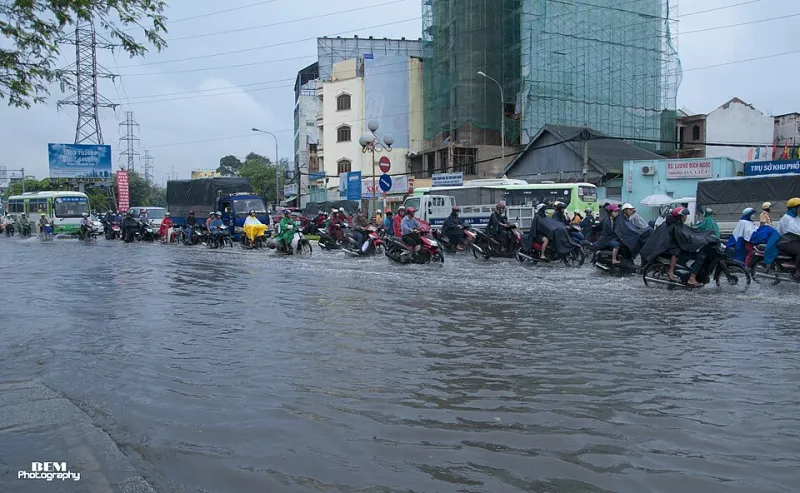
Every Alley Has a Story: Saigon's Delivery Riders Are the Ones Who Remember It
It's 7:14 a.m. on a Tuesday and Nguyen Van Thanh has already logged four deliveries. A bag of bánh mì to a construction site near Bình Thạnh. Two iced coffees to an office tower in District 1. A pharmacy order to an elderly woman in a fourth-floor walkup on a street so narrow his mirrors nearly graze both walls. He knows that street. He's known it for eleven years. He remembers when there was a tailor shop on the ground floor — a man named Ông Minh who worked with his wife until she died, and then kept working alone until the landlord tripled the rent.
"Nobody wrote that down," Thanh says, idling at a red light, helmet pushed back on his forehead. "But I was there. I saw it happen."
In a city that reinvents itself with almost violent speed, the people who move through it every single day — the grab drivers, the xe ôm guys, the Shopee and Giao Hàng Nhanh couriers — have become something nobody planned for: an informal archive of everything Saigon is losing.
The Gig Economy's Accidental Archivists
Saigon's delivery economy is enormous. Estimates suggest hundreds of thousands of riders operate across Ho Chi Minh City on any given day, threading through 24 districts with a spatial intimacy that no urban planner, journalist, or tour guide can match. They are, by necessity, experts in the city's micro-geography — the shortcut behind the wet market, the alley that floods at high tide, the building that used to be a cinema and is now a parking garage.
What makes them unusual as historical sources is precisely what makes them invisible to most visitors: they're always moving, always working, always slightly peripheral to whatever scene they're delivering to. That invisibility is an asset. They see the city without performing for it.
Pham Thi Lan, 44, has been riding for a logistics company since 2016. Before that, she sold fruit from a cart near Chợ Bến Thành. She watched the neighborhood around the market shift block by block — a row of hardware shops replaced by a hotel, a family-run pharmacy absorbed into a chain, a French-era apartment building gutted and reborn as a boutique hostel with exposed brick and craft cocktails.
"Tourists think that building was always like that," she says, gesturing toward a polished facade on Lê Lợi. "They see old bricks and think: history. But those bricks were painted over three times. The family who lived there for forty years is in Bình Dương now."
Routes as Memory Maps
Ask a long-tenured delivery rider to describe their route and what you get isn't directions — it's a timeline. Turns are marked not just by landmarks but by what used to be there. "Turn left at where the noodle shop was." "Go past the corner where they used to sell live chickens on Sunday mornings." The city they navigate is layered, present and past running parallel, only one of them visible to the naked eye.
Trung, a 29-year-old who goes by his nickname Beo and has been doing gig deliveries since he was 19, has developed what he half-jokingly calls his "ghost map" — a mental overlay of the Saigon that existed before the current one. He grew up in District 4, a historically working-class neighborhood that has seen dramatic gentrification pressure over the last decade. He can walk you down a single block and narrate three distinct eras: what it looked like when his grandmother was alive, what it looked like when he started riding, what it looks like now.
"The buildings change faster than people realize," he says. "But the streets stay the same shape. The shape is the memory."
This is actually a profound historical insight. Urban historians have long noted that street patterns outlast virtually everything else — buildings, residents, governments, even languages. Saigon's alley networks, many of them dating to the nineteenth century, encode a spatial logic that predates French colonialism. The riders who navigate them daily are, in some sense, practicing the oldest form of civic knowledge: knowing where you are by knowing where everything used to be.
What Gets Lost When Nobody Writes It Down
None of this is documented in any formal sense. There's no oral history project capturing Thanh's memories of Ông Minh the tailor, no archive preserving Lan's account of the pharmacy that vanished. The riders themselves don't think of what they know as historically significant — it's just their life, their work, the texture of their daily experience.
That's exactly the problem. Cities generate enormous amounts of unofficial knowledge — the kind that lives in the heads of street vendors, night-shift security guards, long-haul bus drivers, and yes, delivery riders — and almost none of it survives the people who carry it. When Saigon's current generation of riders ages out of the gig economy, a specific and irreplaceable layer of urban memory goes with them.
A handful of Vietnamese academics and independent documentarians are starting to pay attention. A small oral history initiative based in District 3 has begun interviewing long-tenured xe ôm drivers, collecting their accounts of neighborhood change alongside hand-drawn maps of routes they've traveled for decades. It's a modest project, under-resourced and largely unknown outside local academic circles. But it's a start.
How to Find This Saigon Yourself
If you're visiting Ho Chi Minh City and want to experience the city the way its riders know it, here's the honest advice: stop optimizing your itinerary and start talking to the people who move through it.
Book a local xe ôm driver — not through an app, but by flagging one down near a neighborhood market — and ask them to take you somewhere they think tourists never go. Tell them you want to see the old version of the street, not the new one. Most riders, once they realize you're genuinely curious rather than just being polite, will open up in ways that no guidebook can replicate.
The conversations won't always be easy — language is a real barrier — but even a few exchanges, with a translation app or a local friend helping out, can reframe an entire visit. You stop seeing Saigon as a collection of attractions and start seeing it as a living palimpsest: a city written over and over on the same ground, with people like Thanh and Lan and Beo as its most faithful, least celebrated readers.
They won't be on the record. They won't have a verified social media presence. They'll be at the next red light, helmet pushed back, watching the city change around them and remembering everything.