The Last Nose in Saigon: Hunting Down the City's Vanishing Perfume Makers

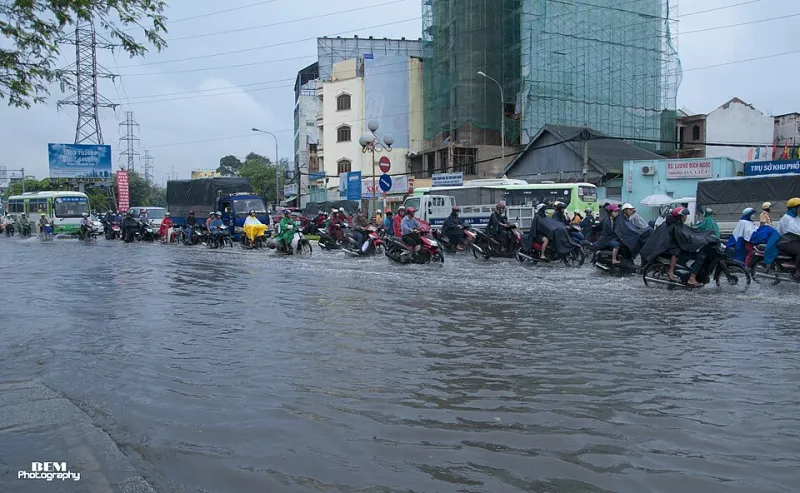
Photo: USDAgov, Public domain, via Wikimedia Commons
Close your eyes anywhere in Ho Chi Minh City and the air tells you exactly where you are. Smoke from a roadside grill. Incense drifting from a temple doorway. The green, vegetal bite of a wet market at six in the morning. Exhaust, jasmine, fish sauce, rain on hot concrete. Saigon has always been a city you smell before you fully see it.
But there's a layer of that olfactory identity that almost nobody talks about — and that almost nobody under sixty has ever encountered. Tucked into the older districts of the city, in shophouses that haven't changed their signage in decades, a small and rapidly aging group of traditional perfumers is still practicing a craft that predates the French colonial period, survived two wars, and outlasted every trend in the global fragrance industry. For now.
What Traditional Saigon Perfume Actually Is
Forget everything you know about Western perfumery — the Chanel No. 5 origin stories, the Grasse flower fields, the celebrity-branded bottles at duty-free. Traditional Vietnamese perfumery, particularly the variant that took root in Saigon during the late nineteenth and early twentieth centuries, is a different animal entirely.
It draws from two deep wells: Chinese medicinal herbalism and the indigenous plant knowledge of the Mekong Delta. The base materials are things like trầm hương (agarwood), long não (camphor), various resins, dried citrus peel, and roots sourced from markets that specialize in traditional medicine. Colonial-era French influence introduced some Western techniques — particularly around alcohol extraction — but the underlying logic of the craft remained distinctly local: scent as something functional, ceremonial, and deeply personal rather than decorative or status-driven.
Custom blending was the norm. A perfumer would interview a client — asking about their constitution, their profession, their spiritual concerns, even the direction their home faced — before selecting and combining materials. The result wasn't a product off a shelf. It was a formulation specific to a person, a season, a purpose.
"My grandmother made a different blend for a wedding than for a funeral," says Bà Hoa, 78, who operates a tiny shop in District 5 that her family has run since the 1950s. "And a different one for a woman who was pregnant than for a man going to sea. Each smell was a conversation."
The Recipes Nobody Wrote Down
Here's the part that should worry you — and that should get you on a plane to Saigon sooner rather than later.
Almost none of these formulas exist on paper. The knowledge lives in the perfumers themselves: in their sense of smell, their muscle memory, their accumulated understanding of how materials interact over time. Bà Hoa learned from her mother, who learned from her mother, in the oldest and most fragile form of knowledge transfer imaginable. There is no apprentice waiting in the back room. Her children work in tech.
This isn't unusual. Across Saigon's traditional perfume community — which, according to those within it, now numbers fewer than two dozen active practitioners — the succession problem is nearly universal. The craft requires years of sensory training that can't be compressed into a weekend workshop or a YouTube series. The raw materials are increasingly difficult to source as wild agarwood becomes scarcer and traditional herb markets give way to pharmacies selling standardized supplements. And the economics are brutal: a custom blend might take a perfumer several hours and cost the equivalent of a few U.S. dollars, in a market where mass-produced fragrances are everywhere and cheap.
When these perfumers die — and the demographic reality is that most of them will within the next decade or two — their formulas die with them. Saigon will lose not just a craft, but a sensory vocabulary it developed over centuries.
What a City Smells Like When It Forgets Itself
This might sound abstract until you think about what scent actually does. Smell is the sense most directly wired to memory and emotion — neuroscientists have been saying this for decades, and anyone who's ever caught a whiff of their grandmother's kitchen and felt time collapse knows exactly what that means. When a place loses its distinctive scent culture, it loses something that can't be photographed or archived or reconstructed from written records.
Saigon's traditional perfumers were, in a very real sense, encoding the city's identity in olfactory form. The blend burned at a Tết altar. The scent applied before a business negotiation. The fragrance that marked a girl's transition to womanhood in a specific family's tradition. These weren't decorative choices. They were cultural acts, performed through smell, that connected living people to their ancestors and their communities.
Lose the perfumers, and you lose the ability to perform those acts authentically. The city can still burn incense — it will always burn incense — but the specific, intentional, handcrafted dimension of its scent culture will be gone.
How to Find Them: A Practical Guide for Curious Travelers
If you want to experience this craft before it disappears, District 5 (Chợ Lớn) is your best starting point. The neighborhood has the highest concentration of traditional medicine shops and, by extension, the herbalists and perfumers who share their supply chains. Look for shops with hand-painted wooden signs rather than printed vinyl banners — it's not a foolproof indicator, but it's a reasonable filter.
Bà Hoa's shop is on a side street off Châu Văn Liêm and doesn't have an English sign. Ask at any traditional medicine shop in the area and mention you're looking for nước hoa truyền thống (traditional perfume) — someone will point you in the right direction.
Another cluster exists in parts of District 3 near the old Bình Tây market area, though these practitioners are harder to find and less accustomed to foreign visitors. Bringing a local friend or a Vietnamese-speaking guide is strongly recommended — not just for translation, but because showing up with someone who can vouch for your genuine interest rather than your tourist curiosity makes a real difference.
Don't expect a slick retail experience. These are working spaces, often cluttered with jars and drying materials and the residue of decades of practice. Come with patience, come with respect, and come prepared to sit and talk — the consultation, however halting across the language gap, is part of the point.
And come soon. The window is narrower than most people realize, and the city's most intimate sensory history is almost out of time.