Follow the Smoke: Saigon Has a Second Map, and Incense Draws Every Line
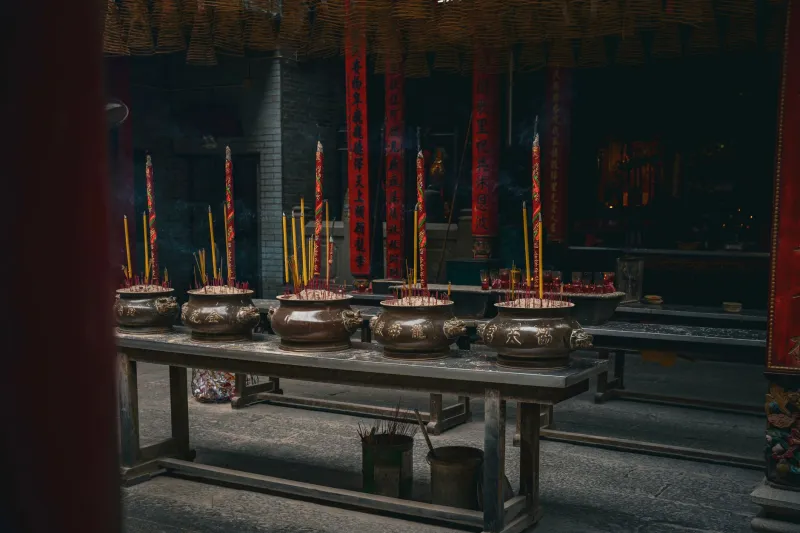
Open Google Maps in Ho Chi Minh City and you'll get streets, landmarks, coffee shops, the usual. It's accurate enough to get you where you're going. But there's a second map layered over the first one — older, denser, and in many ways more useful for understanding how this city actually works. Nobody sells it. Nobody prints it. It's written in smoke.
The incense burning at the small red shrine outside the hardware store on Lê Văn Sỹ isn't decorative. The cluster of joss sticks pushed into a sand-filled urn outside the apartment building entrance on Nguyễn Trãi isn't a photo opportunity. The blue smoke rising from the temple courtyard three blocks from the Bến Thành Market marks a boundary that predates the market, the French colonial street grid, and possibly the city itself. Saigon's spiritual geography is ancient, layered, and completely invisible to most visitors — not because it's hidden, but because you have to know what you're looking at.
What the Shrines Are Actually Saying
The small shrines that appear at seemingly random intervals across Saigon's sidewalks and building facades fall into several overlapping categories, and locals read them the way you might read a neighborhood's real estate signs — as information about who's here, what's valued, and what kind of place this is.
Street-level shrines honoring Thổ Địa, the earth deity, mark the spiritual jurisdiction of a particular plot of land. They're found at the entrances of businesses, homes, and markets, and they communicate something like: this space is claimed, acknowledged, and under protection. The offerings placed there — fruit, incense, sometimes small cups of tea or rice wine — aren't random. They follow a logic of reciprocity that has operated in this city for centuries.
Shrines dedicated to Quan Công, the deified general adopted from Chinese tradition and absorbed into Vietnamese folk religion, tend to cluster in areas with strong Hoa (ethnic Chinese) community roots — which is to say, large sections of Cholon and parts of Districts 5, 6, and 10. If you're trying to understand where Cholon's historical influence actually extended, following the Quan Công shrines will take you further than any official boundary line.
And then there are the ghost shrines — small, often improvised markers placed at the sites of accidents or violent deaths, honoring the wandering spirits of those who died without proper ritual. These are the ones that tend to unsettle visitors when they learn what they're looking at. They also, quietly, map a city's history of violence, accident, and loss in ways that no official record preserves.
Pagodas as Compass Points
Saigon's pagodas are not evenly distributed, and that unevenness is intentional. The placement of major temples reflects centuries of decisions about spiritual power, community protection, and the flow of energy through a landscape. Residents who understand this system navigate the city partly through these anchor points — not just as religious sites, but as orienting landmarks that carry meaning the street names don't.
Giác Lâm Pagoda in Tân Bình District, believed to be the oldest in the city, sits at what was once the western edge of the settled area. Its position wasn't accidental — temple placement in Vietnamese tradition involves careful assessment of topography, water flow, and the directional principles of geomancy. The pagoda was meant to anchor that boundary, to hold something in place spiritually that the physical landscape couldn't guarantee.
The Jade Emperor Pagoda in District 3 — one of the few that actually appears on tourist itineraries — is famous enough that visitors line up to photograph its carved wooden figures and its turtles. What gets mentioned less often is that the pagoda's specific spiritual geography, its orientation, its courtyard layout, and the sequence in which its interior spaces are arranged all encode a cosmological map that practicing worshippers read as naturally as a city planner reads a zoning document.
When you visit a Saigon pagoda as a tourist, you're typically experiencing the surface. The structure underneath — the logic of why it's here, why it faces this direction, why this deity is placed in relation to that one — is a separate and much longer education.
The Ritual Calendar Nobody Publishes
Saigon's spiritual geography isn't static. It pulses. On the first and fifteenth days of the lunar month, the city's shrine activity intensifies visibly — more incense, more offerings, more people making rounds to neighborhood shrines before dawn. During the seventh lunar month, the Hungry Ghost Festival transforms the city's spiritual landscape entirely, with offerings placed not just at established shrines but at roadsides, intersections, and open spaces where wandering spirits might congregate.
If you happen to be in Saigon during these periods and you're paying attention, the city reveals itself differently. The woman burning paper offerings outside her shop at 6 a.m. is not doing something quaint or photogenic. She's maintaining a relationship — with her ancestors, with the spirits of her neighborhood, with forces she understands as real and present and requiring acknowledgment. The smoke rising from that transaction is functional communication, not atmosphere.
The lunar calendar that governs this activity runs parallel to the Gregorian calendar that organizes official Saigon — business hours, government schedules, tourist infrastructure. Understanding that both calendars are real, and that millions of residents navigate by both simultaneously, gets you closer to understanding how layered this city actually is.
Why Outsiders Miss It
The short answer is that the visual language of Vietnamese folk religion doesn't announce itself in ways that Western tourists are trained to recognize as significant. A small red shrine at knee height, half-obscured by a parked motorbike, doesn't look like a religious site to someone who grew up associating religion with dedicated buildings and clear signage. A stick of incense burning in a doorway reads as ambiance rather than active ritual.
There's also a tendency to flatten everything into the category of Buddhism and move on. Vietnamese spiritual practice is genuinely syncretic — it draws on Theravada and Mahayana Buddhist traditions, Taoism, Confucian ethics, indigenous animist practices, and a rich folk religion tradition that doesn't map neatly onto any of those labels. The shrine to the earth deity and the altar to the Buddha in the same household are not contradictions. They're different instruments in the same orchestra.
How to Start Seeing the Second Map
You don't need a guide or a course to begin reading Saigon's spiritual geography. You need to slow down and look lower — most of the shrines are at waist height or below, positioned for the spirits they serve rather than for human eye level. Notice the color red: it marks sacred space across multiple traditions in Vietnamese culture and appears on shrines, door frames, and altar cloths throughout the city.
Pay attention to smoke. Follow it. Not aggressively — don't push into private courtyards or photograph people mid-ritual without acknowledgment — but let it orient you. The places where incense consistently burns are places where something is being maintained. That maintenance is a form of memory, and memory is what this city runs on beneath everything else.
The official map will get you to your hotel. The smoke map will get you somewhere closer to understanding what Saigon actually is.