Grease, Grit, and Genius: Saigon's Motorbike Mechanics Are the Engineers Nobody Hired
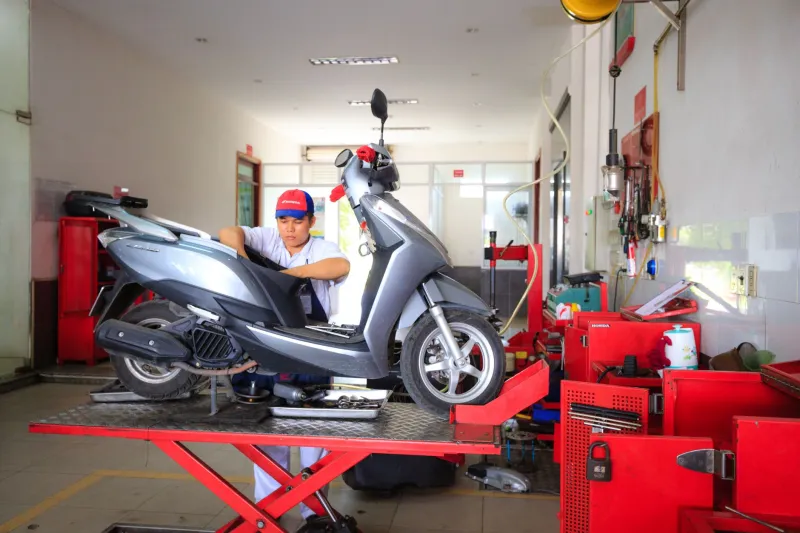
The shop has no sign. It doesn't need one. A rusted Honda Dream balanced on a wooden block, three young guys crouched over a carburetor like surgeons, a radio playing something scratchy and old — this is how you know you've found it. Somewhere in District 3, wedged between a bubble tea stall and a shuttered tailor shop, Minh has been fixing motorbikes since 1987. He learned from his uncle, who learned from a French-trained mechanic in the 1950s. That chain of knowledge runs longer than most people's family trees.
Saigon has roughly nine million registered motorbikes. Maybe more — nobody's really counting the unregistered ones. That number alone should tell you something about how essential these sidewalk mechanics are. But the story of who they are, where they came from, and why they still matter goes a lot deeper than horsepower and spare parts.
The French Left the Roads, and the Vietnamese Fixed What Ran on Them
Colonial-era Saigon was built around French infrastructure priorities: wide boulevards, administrative buildings, river access. The motorbike — initially a European import — became a practical necessity for Vietnamese residents navigating a city designed around the needs of its occupiers rather than its own people. Early mechanics were often self-taught, working from salvaged parts and improvised tools because the formal repair economy was largely controlled by French-owned businesses or their proxies.
That outsider position turned into an advantage. Cut off from official supply chains, Vietnamese mechanics developed a problem-solving culture built on improvisation. You couldn't order the right part? You fabricated one. The engine manual was in French or Japanese? You reverse-engineered the machine until you understood it better than the manual did. This wasn't just resourcefulness — it was a form of technical resistance, a way of saying the city belonged to the people who actually knew how to keep it running.
By the time American military hardware began flooding into Saigon in the 1960s, local mechanics were already practiced in adapting foreign machinery to Vietnamese conditions. Humidity, dust, overcrowded roads, and fuel quality that varied wildly across supply lines — none of it was in any manufacturer's warranty, but Saigon's mechanics handled it anyway.
War as an Unlikely Technical Education
The war years created a paradox: destruction on a massive scale, but also an explosion of mechanical knowledge. Military surplus flooded civilian markets. Engines from American jeeps, parts stripped from abandoned vehicles, fuel tanks repurposed into water storage — the city's mechanics absorbed it all. Older repairmen who were working during this period describe it as a crash course in everything simultaneously, a chaotic university with no tuition and very high stakes.
After 1975, the challenge shifted again. Reunification brought new restrictions on imported goods, which meant the parts pipeline dried up almost completely. Mechanics who had spent years adapting foreign machines now had to make those same machines last indefinitely. Some kept Honda Cubs running for twenty, twenty-five years beyond any reasonable expectation. The technique wasn't just repair — it was a philosophy of extension, of refusing to let useful things die.
This is the part that gets lost when people talk about Vietnamese ingenuity as though it's some kind of charming cultural quirk. It wasn't charming. It was survival, and it produced some of the most sophisticated informal engineering knowledge on the planet.
The Shop as Community Center
Spend an afternoon at any long-running repair stall in Saigon and you'll notice something that doesn't show up in any business model: the place never empties out. Neighbors stop by to talk. A kid drops off his grandmother's scooter and stays for an hour. Someone brings food. The mechanic gives advice on a problem that has nothing to do with engines.
These shops function as neighborhood anchors in a way that's hard to explain to someone from a city where you Yelp a repair shop, drop off your car, and come back two days later. The relationship between a Saigon resident and their motorbike mechanic is closer to the one Americans used to have with a family doctor — built on trust, history, and the understanding that this person knows things about your situation that a stranger couldn't.
That social function is not incidental. It's part of why these shops have survived every economic disruption thrown at them. When you're also the guy who knows which neighbor has a spare part, which alley floods first during monsoon season, and whose cousin can get you a fair price on a used engine, you're not just a mechanic. You're infrastructure.
Silicon Valley Came for the Motorbike Market — and Found It Complicated
Grab, the Southeast Asian super-app, launched aggressive expansion into Vietnam's urban transport market with the promise of algorithmic efficiency. Gojek followed. And for a while, it looked like the app economy might finally disrupt what colonialism, war, and economic isolation couldn't touch.
It's more complicated than that. Yes, younger Saigonese residents use ride-hailing apps constantly. Yes, the number of people who own and maintain their own motorbike has shifted in some demographics. But the repair economy hasn't collapsed — it's adapted, the way it always has. Mechanics now work on the fleets of Grab drivers who need fast, cheap turnaround. They handle the overflow from authorized dealerships that charge three times as much for the same job. And they remain the only real option in the city's outer districts, where the app economy's promises arrive late if they arrive at all.
There's also a generational knowledge problem that no app has figured out how to solve. The older mechanics carry diagnostic intuitions developed over decades — the ability to hear an engine problem before the instruments register it, to feel a vibration pattern that indicates a specific failure mode in a specific model. That knowledge is not in any database. It lives in the hands and ears of people who learned it from someone who learned it from someone else, all the way back to a sidewalk in colonial Saigon.
What Gets Lost When the Stalls Disappear
Urban development pressure is real. Landlords in central districts are selling to developers. Zoning changes push informal businesses toward the periphery. Some mechanics are relocating; others are retiring without anyone to pass their knowledge to, because the young generation sees more economic promise in driving for Grab than in learning a craft that takes years to master.
What disappears with them isn't just a service. It's a way of knowing the city — its rhythms, its hidden connections, the informal systems that keep it functional beneath the official version of itself. Every old mechanic's stall that closes takes a piece of Saigon's living memory with it.
If you're visiting and you want to understand how this city actually works, don't just ride the motorbike. Find the guy who fixes it. Watch him for a while. If he has time, ask him how long he's been there. The answer will tell you more about Saigon than any guidebook has room to say.