The Question Saigon Won't Answer — and Why That's the Point
It happens somewhere around the second or third day. You're at a rooftop bar, or maybe a café in District 1, and you're talking to someone — a guide, a hotel worker, a person you met at a food stall — and the conversation gets comfortable enough that you ask it. The question. The one that's been sitting in the back of your mind since you landed.
What was it really like?
Or some version of it. Do people here still resent Americans? Or: Is it hard to talk about what happened? Or the most loaded one of all: Has Vietnam forgiven us?
And the person you're talking to smiles. They give you something — a short answer, a gracious deflection, a pivot toward something lighter. And the conversation moves on. And you, if you're being honest with yourself, walk away feeling like you almost got there. Like the real conversation was just behind a door that didn't quite open.
Here's what most American visitors don't realize: the door opened. You just didn't know how to read what was on the other side.
The Smile Is Not an Invitation to Push Further
American communication culture tends to treat openness as the default and silence as something to be filled. We're a nation of people who believe that if we ask sincerely enough, and listen carefully enough, we'll eventually get to the truth. We're also, if we're being fair about it, a culture that sometimes confuses emotional processing with emotional performance — where talking about something openly is assumed to be healthier than not talking about it.
Vietnamese communication, particularly around subjects that carry generational weight, operates on different principles. What gets said in public, what gets shared with strangers, and what gets kept inside the family or inside oneself — these are not arbitrary divisions. They reflect a sophisticated understanding of when speech serves a purpose and when it doesn't. When a Saigon local gives you a short answer about the war and steers toward something else, that's not avoidance. That's a complete and intentional communication.
The message, if you're listening for it, is: this is not something I share with someone I met two hours ago, and that boundary is not a problem for me to solve.
Who Gets to Tell the Story?
There's a particular kind of American tourist who arrives in Saigon having read serious books, watched serious documentaries, and developed what they consider a nuanced understanding of the war. They've done the work, they feel, and they want to have a real conversation that reflects that preparation. The problem is that preparation, however genuine, is still a frame built outside Vietnam, from sources that were largely produced by and for Americans.
The Vietnamese experience of the war — all of it, not just the American chapter — is not a single story waiting to be unlocked by the right question. It's millions of stories, many of them contradictory, some of them irreconcilable. A family in District 5 might have memories that directly conflict with a family in District 1, not because one of them is wrong, but because the war moved through different communities in completely different ways. The North Vietnamese soldier's story, the South Vietnamese civilian's story, the Viet Cong fighter's story, the family that lost members on multiple sides of the conflict — these don't collapse into a unified narrative just because an American tourist is ready to hear one.
Asking what was it really like implies there's a single authentic answer, and that you're the appropriate person to receive it. Both assumptions are worth examining.
The City Itself Is the Answer
Saigon's energy — the noise, the speed, the sheer relentless forward motion of the place — is often read by visitors as proof that the city has moved on. And there's truth in that. Vietnam has one of the youngest populations in Southeast Asia. For millions of Saigonese residents, the war is as distant as World War II is for most Americans — something that happened to their grandparents, not to them. The city is genuinely oriented toward the future in ways that aren't performance.
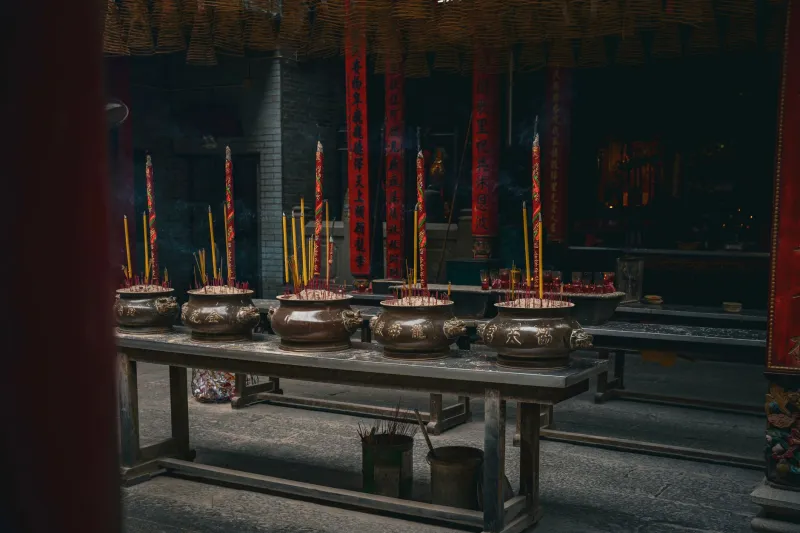
But the city also carries its history in ways that don't announce themselves. The temple that sits between two glass office towers wasn't placed there by accident. The incense burning at the street shrine in front of a luxury hotel is not a tourist attraction — it's a family continuing a practice that predates the building by generations. The older man who doesn't engage with your questions about the war might have a reason for his silence that has nothing to do with resentment or pain and everything to do with a story that was never meant to be shared with a stranger.
The city is answering you. The answer is: look at what we built. Look at how we live. Look at what we kept and what we let go. That's not evasion. That's a complete response.
What Respectful Curiosity Actually Looks Like
None of this means you shouldn't be curious. Curiosity is good. It's probably what brought you here. But there's a difference between curiosity that centers your need to understand and curiosity that makes room for the possibility that some things aren't yours to understand — at least not yet, and not in the way you imagined.
The War Remnants Museum in District 3 is a genuinely important place to visit, but go knowing that it's a specific perspective, not the whole picture. The same is true of every narrative you arrived with. Read Vietnamese authors — Bảo Ninh, Nguyễn Phan Quế Mai, Ocean Vuong — before you decide you know what questions to ask. Talk to people about food, about their neighborhood, about what they're proud of, before you talk about the war. Let relationships develop before you expect them to carry weight.
And when someone gives you a short answer and a smile, try something different. Instead of pushing, try receiving. The smile is real. The redirect is intentional. And the conversation that happens after you stop asking the big question is often the one that actually teaches you something.
The Real Education Is in the Boundaries
America has a complicated relationship with this city, and most thoughtful visitors arrive knowing that. What's harder to internalize is that the complication doesn't get resolved by a single honest conversation with a local. It gets resolved, slowly and imperfectly, by accumulating experiences that don't fit the story you brought with you — and by being willing to sit with that discomfort instead of asking someone else to explain it away.
Saigon will not give you closure. It's not in the business of closure. It's in the business of living, loudly and continuously, in a way that has survived things most Americans can't fully imagine. That survival is not an invitation to extract the story of how it happened. It's an invitation to witness what happened next.
That's the education. It's worth the trip.