I Gave a Saigon Motorbike Driver My Entire Day. Here's What He Showed Me.
I Gave a Saigon Motorbike Driver My Entire Day. Here's What He Showed Me.
Let me be upfront about something: I am the kind of traveler who over-researches. I had a color-coded spreadsheet for this trip. I had offline maps downloaded, restaurant reservation screenshots organized by district, and a ranked list of backup options in case anything was closed. I was, in other words, exactly the kind of tourist that Saigon is very good at humoring while quietly keeping its best stuff hidden.
Hùng changed that.
The Negotiation That Wasn't
I met him outside my guesthouse in District 1 on my fourth morning in the city. He was leaning against a Honda Win that looked like it had opinions, smoking a cigarette with the particular leisure of someone who has nowhere to be and everywhere to go. I'd been warned by other travelers that xe ôm drivers — the motorbike taxi guys who've been the city's unofficial nervous system for decades — were being edged out by Grab, Vietnam's answer to Uber. Hùng did not appear concerned about this.
We haggled briefly over a day rate, landed on something reasonable, and then I did the thing that terrified me most: I put my phone in my bag and told him I had no plan.
He looked at me for a long moment. Then he said, in English considerably better than he'd let on during the price negotiation, "Okay. You eat breakfast yet?"
I had not.
"Good," he said, and handed me a helmet.
Breakfast in a Place That Doesn't Have a Name
We ended up in an alley somewhere in District 4 — I couldn't have found it again with a compass and a local guide — at a folding table outside what appeared to be someone's living room. An older woman was ladling bún bò Huế into bowls with the focused efficiency of a surgeon. The broth was the color of a sunset and smelled like lemongrass and something deeper, more fermented, that I couldn't name.
Hùng ordered for both of us without consulting me. This was, I would learn, his default mode.
I asked him how long the woman had been running this spot. He translated the question, listened to her answer, and said: "She says since 1979. She came from Huế after the war. The recipe is her mother's."
I ate the whole bowl. Then I ate most of Hùng's when he got distracted by a phone call.
The Neighborhood Nobody Told Me About
After breakfast, we crossed the Khánh Hội Bridge into a part of District 4 that felt genuinely removed from the Saigon I'd been moving through all week. The streets narrowed. The buildings got shorter and older. Kids played in an alley between a mechanic's shop and what might have been a small Buddhist shrine, or might have been someone's front hallway — the line was unclear.
 Photo: Khánh Hội Bridge, via assets.puzzlefactory.com
Hùng killed the engine and walked me through slowly, nodding at people, stopping occasionally to exchange a few words. He explained that District 4 used to have a rough reputation — historically a working-class, sometimes dangerous neighborhood that more prosperous Saigonese avoided. "Now people discover it," he said, with a tone that landed somewhere between pride and mild suspicion.
We stopped at a wall covered in faded painted advertisements — the kind of hand-lettered commercial art that predates the digital era by decades. Hùng photographed it with his own phone. "For my daughter," he explained. "She studies design."
I had not expected that.
The Lunch Detour That Took Two Hours
Around noon, Hùng announced we were going to Bình Thạnh for lunch. I had Bình Thạnh on my spreadsheet — it's a district that's been quietly gentrifying, mixing old residential streets with newer creative spaces — but I'd planned to spend maybe ninety minutes there. Hùng had other ideas.
We parked near a market that smelled aggressively of fish sauce and dried shrimp, which is to say it smelled fantastic. He led me through it like he was giving a tour of his own house — pointing out a particular vendor who sold the best dried squid in the city, pausing at a stall where a man was pressing sugarcane juice with a hand-cranked machine that looked like it was built during the Kennedy administration.
Lunch was cơm tấm — broken rice with grilled pork, a fried egg, and a small bowl of broth — at a place with no signage visible from the street. We ate at a table with a family of four who were completely uninterested in my presence, which felt like a genuine compliment.
I asked Hùng what he thought about the way Saigon was changing — the new towers, the Grab drivers, the tourists with their spreadsheets.
He shrugged. "Saigon always changes. That's why it's Saigon." He paused. "Ho Chi Minh City changes too. Depends which city you're in."
I wrote that down.
Late Afternoon and a Temple I Almost Missed
By 4 p.m. we were in Bình Chánh, a district on the western edge of the city that most tourists never reach. Hùng had mentioned, almost casually, that there was a temple out this way worth seeing. He had undersold it considerably.
It was a Cao Đài assembly hall — smaller than the famous one in Tây Ninh but somehow more striking for its neighborhood context, sitting between a tire shop and a row of houses like it had always been there and always would be. The exterior was painted in the Cao Đài palette of white and pastel yellow, with the divine eye symbol above the entrance watching us arrive.
 Photo: Cao Đài assembly hall, via cdn.ship24.com
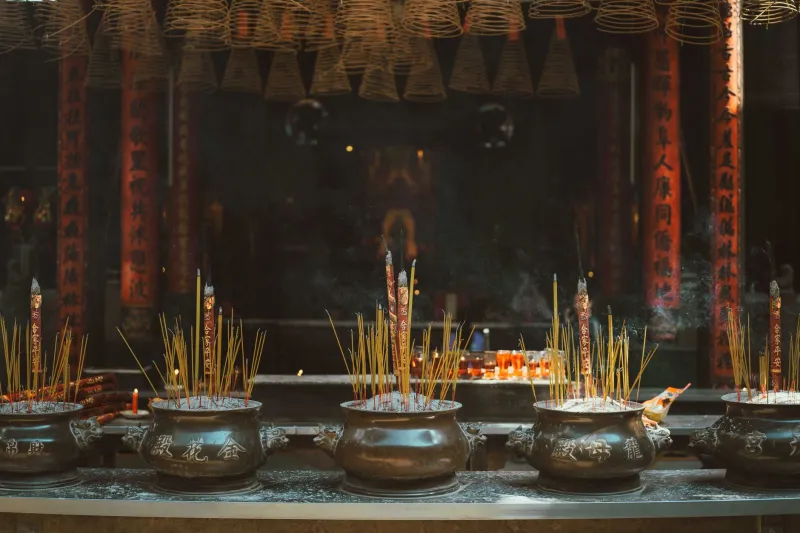
A caretaker let us in. The interior was cool and quiet. Hùng lit incense at a side altar, not for show, just because he always did when he came here. He'd been coming since he was a kid, he said. His grandmother had been a Cao Đài follower.
We stood there for a few minutes without talking. The city noise disappeared almost entirely.
What I Actually Learned
We made it back to District 1 just before dark, the traffic thickening around us into the spectacular chaos of Saigon's evening rush — a thousand motorbikes moving with the fluid logic of a school of fish, everyone threading through gaps that shouldn't exist but somehow do.
Hùng dropped me at my guesthouse and we settled up. I tipped more than I'd budgeted for, which he accepted without comment.
Here's what no app or itinerary gave me that day: the sensation of a city revealing itself on its own terms. Hùng didn't take me to the War Remnants Museum or the Reunification Palace. He took me to a 45-year-old soup recipe, a wall that his daughter might draw inspiration from, a temple where his grandmother used to pray. He took me to the Saigon that exists underneath the one designed for visitors.
You can plan a trip to this city down to the minute. You can hit every landmark and eat at every restaurant on every list. And you'll have a perfectly good time.
Or you can put your phone in your bag and let someone who actually lives here drive.
The helmet's a little loose, but the view is worth it.