Smoke, Silk, and Secret Societies: The Hidden World of Cholon, Saigon's Chinatown
Smoke, Silk, and Secret Societies: The Hidden World of Cholon, Saigon's Chinatown
There's a moment, somewhere between the incense-thick air of Thien Hau Pagoda and the chaotic wholesale markets of Binh Tay, when Cholon stops feeling like a neighborhood and starts feeling like a separate country. The signs shift from Vietnamese to Chinese. The smells change — dried seafood, medicinal herbs, roasting duck fat. The pace quickens in ways that even Saigon's famously relentless energy doesn't quite match. You're still in Ho Chi Minh City, technically. But Cholon has always operated by its own rules.
 Photo: Thien Hau Pagoda, via adu.edu.az
Most American visitors treat it like a day trip — a few pagoda photos, maybe a bowl of something unfamiliar, and back to District 1 before dinner. That's a shame, because what they're skipping is one of the most layered, complicated, and quietly powerful neighborhoods in all of Southeast Asia.
The City Before the City
Cholon — the name literally means "big market" in Vietnamese — predates the French colonial version of Saigon by a generation. Chinese merchants, primarily from the Cantonese, Teochew, Hokkien, and Hakka communities, began settling the area in the late 18th century, drawn by the Mekong Delta's agricultural wealth and the natural trading advantages of the waterways. By the time the French arrived and started drawing maps, Cholon was already a functioning commercial metropolis with its own financial systems, its own governance structures, and its own social hierarchies.
The French formalized the separation — Cholon was technically a distinct municipality from Saigon until 1932 — but they also depended on it. The Hoa, as ethnic Chinese Vietnamese are known, controlled rice trading, money lending, and a significant portion of the region's import-export economy. French colonial administrators were sharp enough to recognize that disrupting Cholon's merchant class would destabilize the entire delta. So they largely left it alone.
That arrangement — tolerated, useful, never fully trusted — would define the Hoa community's relationship with every government that followed.
The Kongsi System: Shadow Government, Open Secret
To understand how Cholon actually functioned, you have to understand the kongsi. These were clan associations and dialect-based mutual aid societies that Chinese immigrant communities established across Southeast Asia wherever they settled in significant numbers. In Cholon, they were everything: bank, court, social safety net, and political machine rolled into one.
The five major dialect groups each had their own kongsi, their own meeting halls (many of which still stand), and their own networks of loyalty. Disputes between merchants were settled internally. Loans were extended based on clan reputation rather than collateral. New arrivals from Guangdong or Fujian didn't land in a foreign city — they landed inside a system that already knew who they were.
Western history books tend to sensationalize this as "secret society" activity, and there were certainly criminal elements woven into parts of the network. But framing it purely as organized crime misses the point. The kongsi system was functional governance for a community that couldn't fully rely on any external authority. It was how Cholon survived.
War Comes to the Big Market
Cholon's role during the American War era is one of the most underexamined chapters in the neighborhood's history. During the 1960s, it was simultaneously a refuge for those fleeing conflict in the countryside, a logistics hub for the South Vietnamese economy, and — depending on which intelligence report you read — a corridor for black market goods, weapons, and money flowing in directions that didn't always align with official policy.
The 1968 Tet Offensive hit Cholon especially hard. Some of the fiercest urban combat of the entire war played out in its streets. Buildings that had stood for a century were reduced to rubble in days. The neighborhood rebuilt, as it always had. But the political ground was shifting underneath it.
When Saigon fell in 1975, the Hoa community faced an almost impossible situation. Many had prospered under the South Vietnamese government and its American-backed economy. The new government viewed them with deep suspicion — not just as capitalists, but as a potential fifth column for China, with whom Vietnam's relationship was deteriorating rapidly.
The Exodus and What It Left Behind
Between 1978 and 1979, as Vietnam and China moved toward open military conflict, the government launched a series of campaigns targeting private enterprise — campaigns that fell disproportionately on Cholon's merchant class. Businesses were nationalized. Assets were seized. And in one of the largest refugee movements of the late 20th century, hundreds of thousands of ethnic Chinese Vietnamese fled the country by boat.
These were the "boat people" that American news coverage of the late 1970s occasionally acknowledged but rarely contextualized. A significant portion of them were Hoa from Cholon — doctors, merchants, teachers, entire family dynasties — scattered across refugee camps in Malaysia, Hong Kong, and the Philippines before eventually resettling in California, Texas, Australia, and France.
Cholon didn't die. But it hollowed out. Shops closed. Temples sat half-empty. The institutional memory embedded in those kongsi networks — the relationships, the trade routes, the informal credit systems — walked out the door with the people who left.
The Quiet Comeback
Doi Moi, Vietnam's economic reform program launched in 1986, changed the calculus again. Private enterprise was gradually re-legalized. Some Hoa families who had stayed began cautiously rebuilding their businesses. A smaller number of overseas Hoa returned, drawn back by opportunity and, in some cases, by the pull of a place that still felt like home even after everything.
Today's Cholon is not the Cholon of 1970. The demographics have shifted — Vietnamese families have moved into neighborhoods that were once exclusively Hoa, and the sharp dialect-group boundaries of the old kongsi system have blurred considerably. But the commercial DNA is intact. The wholesale markets around Binh Tay still move astonishing volumes of goods. The traditional medicine shops on Hai Thuong Lan Ong Street still supply herbalists across the region. And if you know where to look, the old clan halls are still there, still functioning, still hosting community events that connect the present to a past most outsiders don't know existed.
How to Actually Experience Cholon
Forget the two-hour pagoda circuit. If you want to understand Cholon, start early — before 7 a.m. — at the edges of Binh Tay Market, when the wholesale buyers are moving through and the rhythm of the place is purely functional, not performative. Eat breakfast at one of the Teochew congee shops that have been serving the same recipes for three generations. Walk down Luong Nhu Hoc Street and look at the paper offerings shops — the elaborate ritual goods burned at funerals and festivals — and consider what they say about how a community maintains its identity across centuries and catastrophes.
 Photo: Binh Tay Market, via climbup.fr
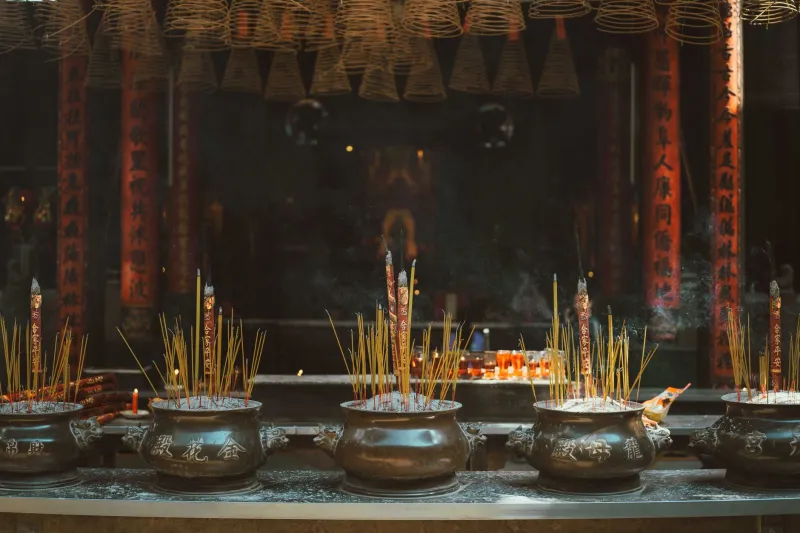
Then find the Nghia An Assembly Hall, tucked away from the main tourist circuit, and sit with it for a while. The carved wooden altar panels, the hanging incense coils, the faded photographs of community founders — it's all still there, still tended, still meaningful to the people whose grandparents built it.
 Photo: Nghia An Assembly Hall, via cdn.motor1.com
Cholon doesn't explain itself to visitors. It never has. That's not rudeness — it's history. A neighborhood that has survived colonial administration, world war, civil war, communist consolidation, and mass exodus doesn't owe anyone a guided tour. But if you come with patience and genuine curiosity, it will show you more than almost anywhere else in this city. And in a city full of layers, that's saying something.