Seven Lives That Built Saigon: The Legends Your History Teacher Never Mentioned
Every legendary city has its cast of characters — the people whose ambitions, obsessions, and defiances left permanent marks on the place. New Orleans has its jazz architects and voodoo queens. New York has its immigrant dreamers and Harlem Renaissance giants. Saigon has its own roster of larger-than-life figures, equally extraordinary, and almost entirely unknown to Western audiences.
That's not an accident. The story of Vietnam that most Americans absorbed — if they absorbed any at all — tends to stop and start with a single decade of conflict. What gets lost in that narrow frame is centuries of artists, builders, cooks, rebels, and thinkers who made Ho Chi Minh City the place it is today.
Consider this your corrective. Seven figures. Seven stories. Seven places in the city where their legacies are still very much alive.
1. Trịnh Công Sơn — The Bob Dylan of Saigon
Where to find him: Café Trịnh, 47C Phạm Ngọc Thạch, District 3
 Photo: Trịnh Công Sơn, via tdc0tj.vtexassets.com
If you tried to explain Trịnh Công Sơn to an American audience, you'd probably reach for Bob Dylan — and then immediately realize the comparison undersells both men. Sơn was a songwriter, painter, and poet who composed over 600 songs during some of the most turbulent decades in Vietnamese history. His anti-war ballads were banned by both sides of the conflict at various points. He didn't care.
His music — delicate, melancholic, achingly human — became the unofficial soundtrack of a generation navigating impossible choices. Songs like Diễm Xưa and Nối Vòng Tay Lớn are still played in cafés across Vietnam with the kind of reverence Americans reserve for Springsteen.
Café Trịnh, tucked into a leafy street in District 3, is a shrine as much as a coffee shop. His paintings line the walls. His records spin on old equipment. Order a cà phê sữa đá, sit with it, and let the music do what it's been doing for fifty years.
2. Madam Phương — The Woman Who Fed a Revolution
Where to find her: Phương restaurant legacy, Bình Thạnh district
History books are full of generals. They're shorter on the women who kept everyone fed. Madam Phương — whose full story is pieced together through oral histories and the memories of her regulars — ran a series of makeshift food operations across Saigon during and after the war years that became, in practice, community lifelines.
Her genius was the kind that doesn't get taught in culinary schools: an instinct for feeding large numbers of people with whatever was available, transforming scarcity into something that tasted like abundance. The dishes she pioneered — layered, resourceful, built on the logic of using everything — influenced a generation of cooks who went on to define what Saigon food means to the world.
Her direct culinary descendants still operate in Bình Thạnh. Ask around at the older noodle shops on Đinh Tiên Hoàng. Someone will know the lineage.
3. Huỳnh Tấn Phát — The Architect Who Drew a Different Future
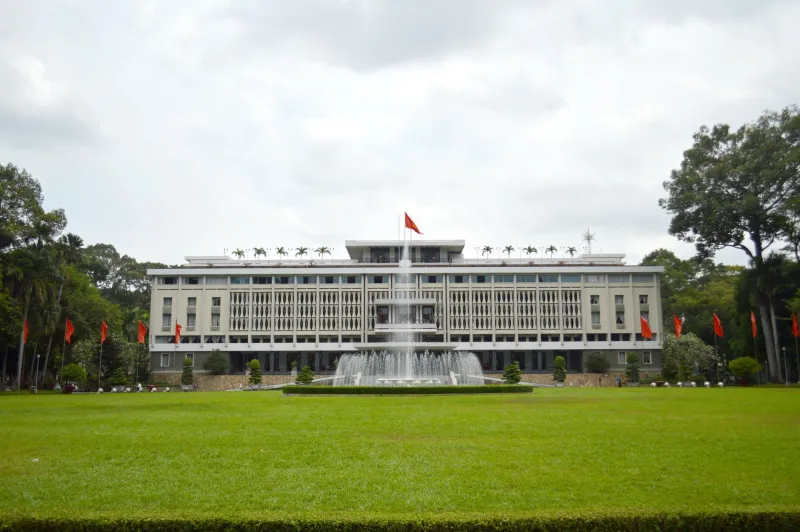
Where to find him: The Reunification Palace, 135 Nam Kỳ Khởi Nghĩa, District 1
 Photo: Reunification Palace, via m.media-amazon.com
Most visitors to the Reunification Palace know it as the building where the Vietnam War ended — the place where a tank crashed through the gates on April 30, 1975. Fewer know the name of the man who designed it: Ngô Viết Thụ, a Vietnamese architect who won the Prix de Rome and brought a distinctly Vietnamese modernism to a building that could easily have been generic colonial pastiche.
But the figure worth knowing alongside the palace's architecture is Huỳnh Tấn Phát — a trained architect who became one of the most important political strategists of the resistance movement, and who used his design background to think systematically about what a rebuilt, independent Vietnam could look like. He understood that architecture was politics made physical.
Walking through the Reunification Palace with both men in mind changes the experience entirely. You stop seeing a historical monument and start seeing an argument — about identity, sovereignty, and what it means to build something that belongs to you.
4. Tôn Thất Tùng — The Surgeon Who Worked in a Bomb Shelter
Where to find him: Chợ Rẫy Hospital, 201B Nguyễn Chí Thanh, District 5
Dr. Tôn Thất Tùng is not a household name in America. He should be. A pioneering hepatic surgeon who developed a faster, safer method of liver resection now known internationally as the "Vietnamese method," he performed groundbreaking operations under conditions that would shut down a modern OR in about thirty seconds — limited equipment, intermittent power, the constant pressure of wartime resource scarcity.
His contributions to surgery are taught in medical schools globally, often without attribution to their origin. He trained generations of Vietnamese doctors who went on to build the country's medical infrastructure essentially from scratch.
Chợ Rẫy, one of Saigon's largest and most historic hospitals, carries the spirit of that era. It's a working hospital, not a tourist site — but walking its perimeter and understanding what was built here, under what circumstances, reframes the entire city around you.
5. Bùi Giáng — The Mad Poet of the Back Alleys
Where to find him: The streets of District 3, particularly around Võ Thị Sáu
Every legendary city has its holy fool — the figure who wanders its streets dispensing wisdom in a form nobody quite understands until later. Saigon had Bùi Giáng.
A poet, translator, and philosopher who was institutionalized multiple times and chose to live much of his later life on the streets of District 3, Giáng translated Camus, Heidegger, and Shakespeare into Vietnamese while composing poetry that Vietnamese scholars are still unpacking decades after his death. He was, depending on who you ask, a genius, a madman, or proof that the line between those two things is mostly a matter of comfort level.
He became a kind of living landmark — locals would look out for him, feed him, argue with him, collect the poems he scrawled on whatever paper was nearby. His presence on those streets was itself a kind of art. Walk the shaded blocks around Võ Thị Sáu in the early evening and you can almost feel the eccentric energy he left behind.
6. Nguyễn Thị Định — The General Nobody Taught You About
Where to find her: Bến Tre Province (day trip from Saigon) and the Women's Museum, 202 Võ Thị Sáu, District 3
 Photo: Nguyễn Thị Định, via foto.haberler.com
Nguyễn Thị Định became the first female general in Vietnamese military history — a fact that, in any other national narrative, would be the kind of story that gets a Hollywood treatment and a statue in every major city. Instead, she remains almost entirely absent from Western historical consciousness.
She led the Bến Tre Uprising in 1960, organized resistance networks across the Mekong Delta, and rose to become deputy commander of the People's Liberation Armed Forces. She did this while navigating a political and military culture that had every structural reason to sideline her, and she refused, repeatedly, to be sidelined.
The Women's Museum in District 3 tells her story alongside dozens of other Vietnamese women whose contributions to the country's history have been systematically undervalued in Western accounts. It's one of the most quietly powerful museum experiences in all of Saigon.
7. Phạm Xuân Ẩn — The Spy Who Loved the City He Served Two Masters For
Where to find him: The old Reuters and Time bureau area, Lam Sơn Square, District 1
The story of Phạm Xuân Ẩn is so cinematic it barely seems real. For years, he worked as a journalist for Time magazine and Reuters — befriending American reporters, generals, and CIA officers — while simultaneously operating as one of North Vietnam's most effective intelligence agents. He was, by all accounts, genuinely beloved by the Americans who knew him. He was also, by all accounts, genuinely committed to Vietnamese independence.
After reunification, he was awarded the title of Hero of the People's Armed Forces. He was also, reportedly, deeply melancholy about what the war had cost everyone involved.
His story — told compellingly in Thomas Bass's book The Spy Who Loved Us — is the perfect lens for understanding Saigon's complexity. A man who contained multitudes, in a city that has always contained multitudes. The streets around Lam Sơn Square, where the foreign press corps once gathered, still carry that layered, watched feeling. Stand there long enough and you'll understand exactly why he was so good at his job.
Saigon's legends aren't in the textbooks most Americans grew up with. They're in the cafés, the back alleys, the hospital corridors, and the shaded streets of District 3. Follow the motorbike long enough, and you'll find them.